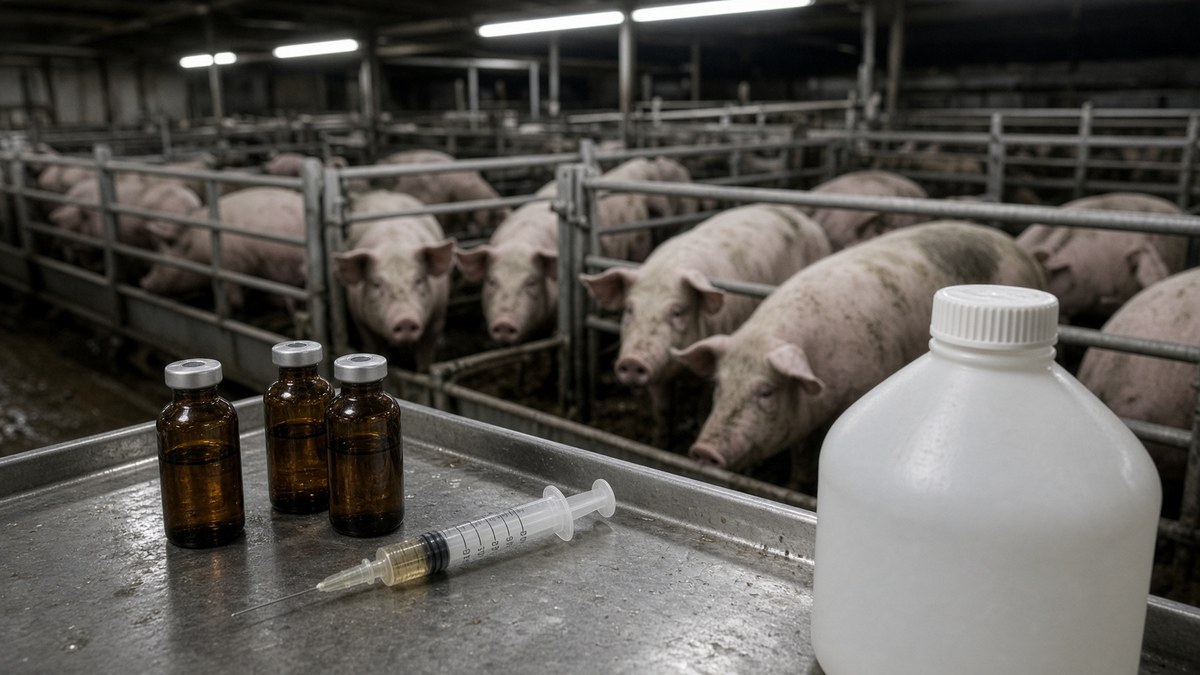
Antibiotics
Most of the world’s antibiotics go to farm animals, not people.
73%of antibiotics sold worldwide go to animals raised for food
In the U.S., about 70% of medically important antibiotics go to farm animals[3], and the worldwide figure is similar, at 73%[1][2]. Antibiotic resistance kills humans[5][6]. The Lancet counted about 1.27 million human deaths in 2019 caused directly by bacterial resistance and about 4.95 million associated with it[5], and the CDC estimates 2.8 million Americans are affected by antibiotic-resistant diseases each year[6]. We harm ourselves by harming animals.
These drugs keep failing because we keep using them on farm animals, which breeds resistance[1][7][9]. The Lancet’s 2024 forecast is about 1.91 million human deaths a year by 2050 caused directly by resistance, and about 8.22 million associated[8]. The UK’s O’Neill review projected a worse path, 10 million human deaths a year by 2050[7], if resistance keeps rising. If you want antibiotics to keep working, stop eating animals.
What the evidence says
The main points first. Every claim is tied to a source below.
About 73% of the world’s antibiotics go to farm animals
Van Boeckel and colleagues, writing in Science, found that 73% of all antimicrobials sold on Earth are used in animals raised for food[1]. Our World in Data reaches the same number: about 85,000 tonnes a year in those animals against about 35,000 tonnes in people, or around 70 to 73%[3].
Most of the world’s antibiotic supply is mixed into feed and water for cows, pigs, and chickens so that crowded barns do not collapse into disease.
Read full article →In the U.S., about 70% of the medically important ones go to farm animals
About 70% of medically important antibiotics sold in the United States are for animals rather than humans[1]. These are the same drug classes doctors use for pneumonia, sepsis, and surgery.
The FDA’s 2024 sales report counted about 7.1 million kilograms for food-producing animals[2], up about 16% in one year[2], with pigs and cows taking most of it. Growth promotion was pulled from the label, but the crowding stayed, so the drugs kept flowing as “prevention.”
Read full article →Resistance already kills people, and the forecast is worse
The Lancet counted about 1.27 million human deaths in 2019 caused directly by bacterial resistance[1], and about 4.95 million associated with it[1]. CDC estimates that about 2.8 million Americans are affected by antibiotic-resistant disease each year[3].
These drugs keep failing because we keep using them on farm animals, which breeds resistance. The Lancet’s 2024 forecast is about 1.91 million human deaths a year by 2050 caused directly by resistance[2], and about 8.22 million associated[2]. The UK’s O’Neill review projected a worse path, 10 million human deaths a year by 2050[4], if resistance keeps rising[4]. Resistant bacteria do not stay in the barn; they move through meat, manure, water, workers, and hospitals.
Read full article →We harm ourselves by harming animals
Factory farms pack animals so tightly that infection is part of the business model, then cover it with the same antibiotics we need for surgery and childhood illness. The dosing is how the system is designed to run.
A vegan diet does not need those barns, so it does not need that dosing. If you wanted medicine to keep working, you would stop eating animals.
Read full article →Articles
Most of the world’s antibiotics go to farm animals
About 73% of the antimicrobials sold worldwide are used in animals raised for food. That use breeds resistant bacteria, and resistance already kills more than a million people a year.
Read full article →
Sources
Papers and datasets. Each card keeps its caveats, including small samples and single-animal cases.
[1]Science, 2019 · Review
Van Boeckel et al. — 73% of antimicrobials sold go to food animals
Globally, 73% of all antimicrobials sold on Earth are used in animals raised for food. Studies have increasingly linked this practice with the rise of antimicrobial-resistant infections in animals and in humans.
[2]Our World in Data · Review
Our World in Data — antibiotics in farm animals
Around 70–73% of antibiotics used globally have been estimated to go to farm animals, not people, based on biomass-weighted use.
[3]Scientific American · Review
Scientific American / U.S. medically important antibiotics
About 70% of medically important antibiotics sold in the U.S. are for animals, not humans.
[4]U.S. FDA, 2025 · Review
FDA — 2024 antimicrobial sales for food-producing animals
U.S. sales and distribution of medically important antimicrobial drugs for food-producing animals increased about 16% from 2023 to 2024, to about 7.1 million kilograms.
[5]The Lancet, 2022 · Meta-analysis
Lancet — global deaths from bacterial AMR, 2019
About 1.27 million human deaths were directly attributable to bacterial antimicrobial resistance in 2019, and about 4.95 million human deaths were associated with it.
[6]CDC, 2019 AR Threats Report · Review
CDC — U.S. antibiotic resistance threats
More than 2.8 million antimicrobial-resistant infections occur in the U.S. each year, and more than 35,000 people die as a result.
[7]Review on AMR, 2016 · Review
O’Neill Review on Antimicrobial Resistance
The UK-commissioned review projected that without action, antimicrobial resistance could cause 10 million human deaths a year by 2050, and named farm-animal antibiotic use as a driver.
[8]The Lancet, 2024 · Review
Lancet — 39 million human deaths from AMR, 2025–2050
Naghavi et al. 2024: about 1.91 million human deaths a year attributable to bacterial AMR in 2050, and about 8.22 million associated. About 39 million human deaths attributable from 2025 to 2050, and about 169 million associated.
[9]World Health Organization · Review
WHO — antimicrobial resistance fact sheet
WHO lists antimicrobial resistance among the top global public health threats. Overuse in people and in animals raised for food both select for resistant bacteria.