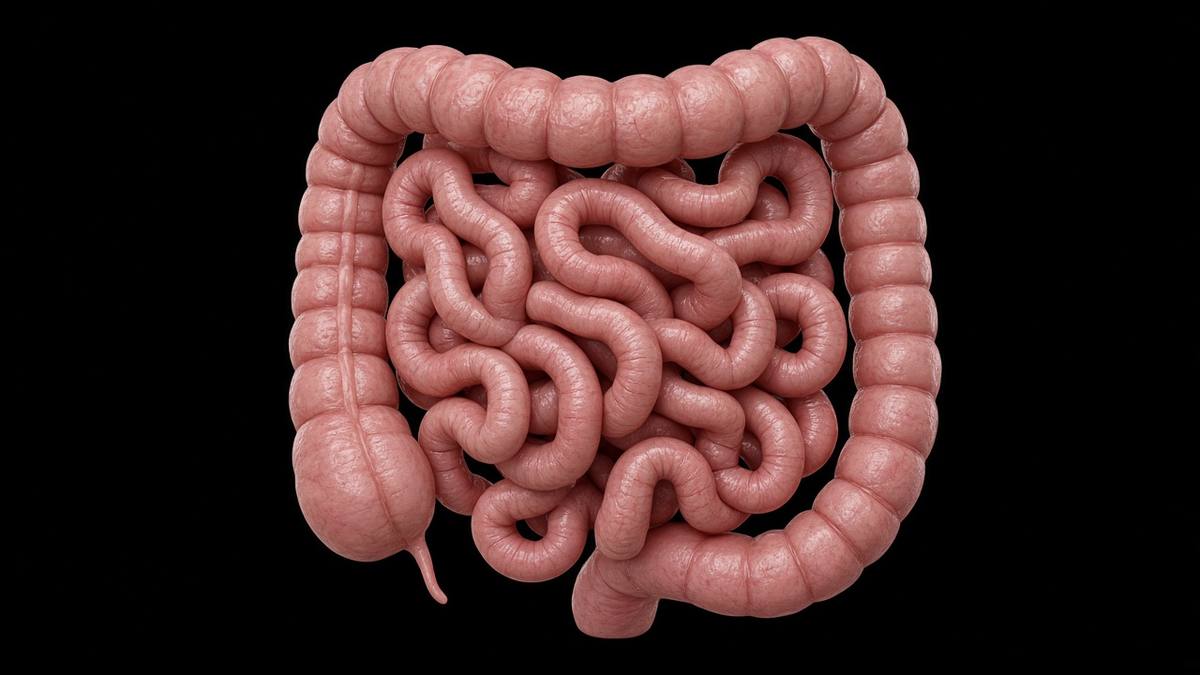
Gut
A different gut on plants, and Crohn’s that stayed in remission
94%Crohn’s still in remission on plants, against 33% eating animals
Across 21,561 people, each diet left its own microbial signature[1]. Red meat was the strongest driver of the omnivore signature[1], and those microbes tracked with worse cardiometabolic health[1]. The vegan-signature microbes tracked with better markers[1], and they also turned up in omnivores who ate more plants[1]. Fibre feeds the difference, raising lactic-acid bacteria and Roseburia and lowering Clostridium and Enterococcus[3]. Among 22 adults with Crohn’s disease already in remission, 15 of the 16 who kept eating plant-based (94%) were still in remission two years later, against two of the six who went back to eating animals[5].
What the evidence says
The main points first. Every claim is tied to a source below.
Each diet left its own signature in the gut, with red meat driving the omnivore one
Across 21,561 people, vegans, vegetarians and omnivores each carried a distinguishable microbial signature[1]. Red meat was the strongest driver of the omnivore signature[1], and those microbes tracked with worse cardiometabolic health[1]. The vegan-signature microbes tracked with better markers and turned up in omnivores who simply ate more plants[1]. Fibre feeds the difference: reviews find that plant-based eating raises lactic-acid bacteria, Roseburia and E. rectale and lowers Clostridium and Enterococcus[2].
Read full article →Crohn’s disease stayed in remission in 94% of patients who kept eating plants
Researchers asked 22 adults with Crohn’s disease already in remission to keep eating a plant-based diet for two years[1]. Of the 16 who did, 15 (94%) were still in remission, compared with two of the six (33%) who went back to eating animals[1]. It was a single hospital with no randomization[1], and the numbers are small[1].
Read full article →Articles
Eating plants gives the gut a healthier set of bacteria
Across 21,561 people, red meat drove a gut profile tied to worse cardiometabolic health while plant eating built one tied to better markers, and in a small study 94% of Crohn’s patients who kept eating plants stayed in remission for two years.
Read full article →
Sources
Papers and datasets. Each card keeps its caveats, including small samples and single-animal cases.
[1]Nature Microbiology, 2025 · Observational
Gut bacteria of 21,561 vegans, vegetarians, and omnivores
Each diet left its own microbial signature. Red meat was the strongest driver of the omnivore signature, and those microbes tracked with worse cardiometabolic health, while the vegan signature microbes tracked with better markers and also showed up in omnivores who ate more plants.
[2]Nutrients, 2014 · Review
The vegan gut — what the microbiome work adds up to
Reviewing the microbiome studies, the authors describe the vegan gut as unusual on two counts: fewer of the bacteria that turn harmful and more of the protective species. They argue lower inflammation is the link between that profile and the health advantages.
[3]Frontiers in Nutrition, 2019 · Review
What vegan and vegetarian diets do to gut bacteria
Review: plant-based eating comes with a more diverse, more stable microbiome. Fibre raises lactic-acid bacteria, Roseburia, and E. rectale, and lowers Clostridium and Enterococcus.
[4]Medicina, 2020 · Review
The vegan gut — which bacteria, and what they make
Review: well-planned vegan diets shift both the bacterial mix and its metabolic pathways, with fibre, polyphenols, and antioxidant vitamins doing the work. The same review notes the nutrients a vegan diet has to plan for.
[5]World Journal of Gastroenterology, 2010 · Small sample
Crohn’s disease staying in remission
22 adults already in remission were asked to keep eating a plant-based diet for two years. Of the 16 who did, 15 stayed in remission (94%); of the six who returned to eating animals, two did (33%). By survival analysis, remission ran 100% at one year and 92% at two. The study was small, at a single hospital, and not randomized.
[6]Translational Pediatrics, 2019 · Review
Plant-based diets for inflammatory bowel disease
Reviewing the evidence for children and adults, the authors recommend plant-based diets for inflammatory bowel disease without reservation, naming diets high in animal fat and low in fruit and vegetables as the pattern most often tied to higher risk.
[7]Expert Review of Gastroenterology & Hepatology, 2020 · Review
Diet in inflammatory bowel disease — how strong is the case
A westernized diet tracks with both the risk of inflammatory bowel disease and relapse, and a plant-based diet may help by lowering inflammation and restoring a balanced gut. The authors are explicit that better-quality studies are still needed.