Animals
They are someone, not something
88BLand animals killed in 2024
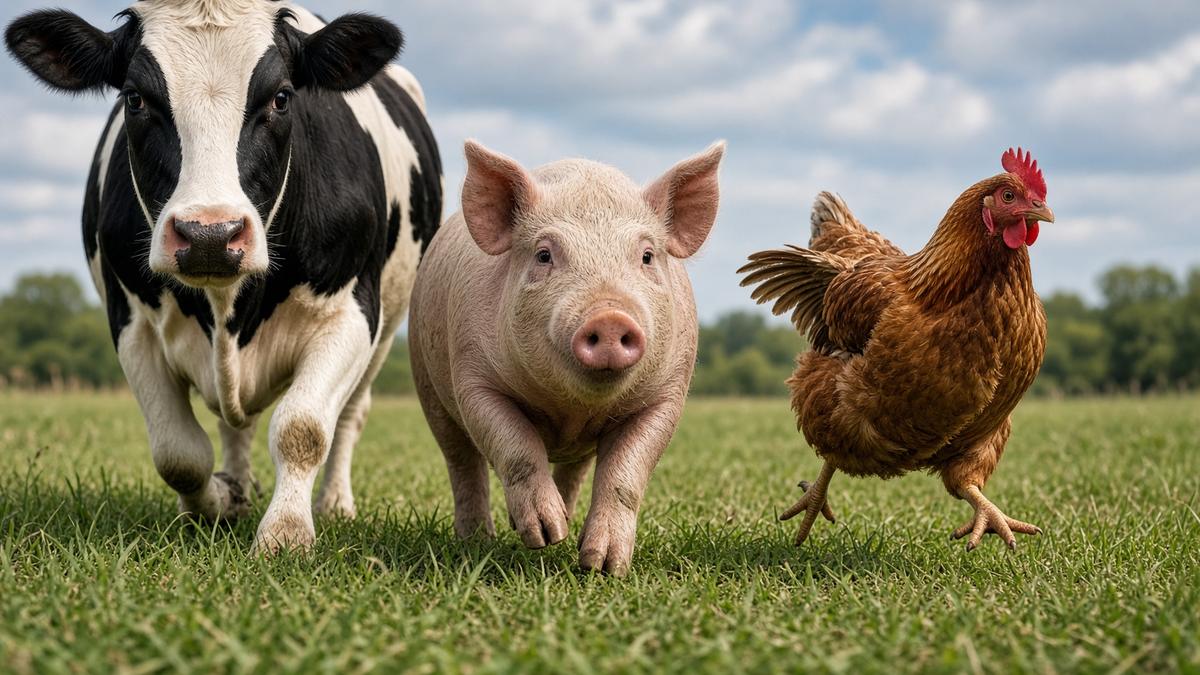
We slaughter about 88 billion land animals every year[1], plus trillions of fish[5][12]. Each of them is someone. Cows use tools[6], pigs are as smart as dogs on many tests[7], chicks can recognize faces and count[8][9], and fish feel pain[10]. Scientists now say mammals and birds are conscious, and fish may well be too[3][4]. Enjoying the taste of an animal does not give us the right to kill one, and we do not have to harm or eat animals at all.
88B
Land animals slaughtered in 2024
About 241 million land animals every day, and that still leaves out fish, who make up most of the total.
Who they are
The main points first. Every claim is tied to a source below.
Scientists say mammals and birds have what it takes to be conscious, and fish might be too
In 2012, neuroscientists at the Francis Crick Memorial Conference declared that, by the weight of the evidence, humans aren’t the only animals with the brain machinery that generates consciousness[1]. All mammals and birds have it too[1]. In 2024, the New York Declaration went further: it says there’s at least a realistic possibility of conscious experience in all vertebrates, fish included[2], and in many invertebrates. Once scientists are saying that, treating these animals as objects is a choice we make.
Read full article →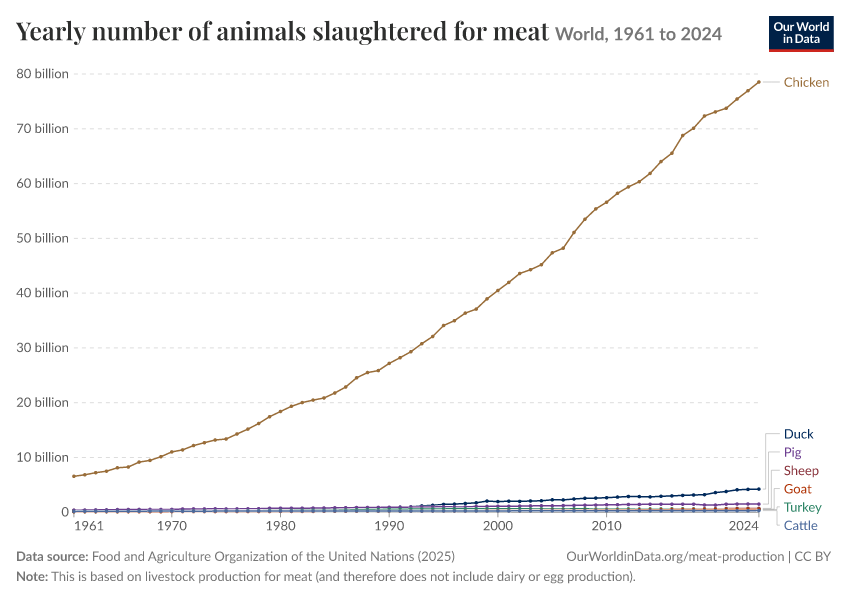
Our World in Data · animals slaughtered for meat · FAO
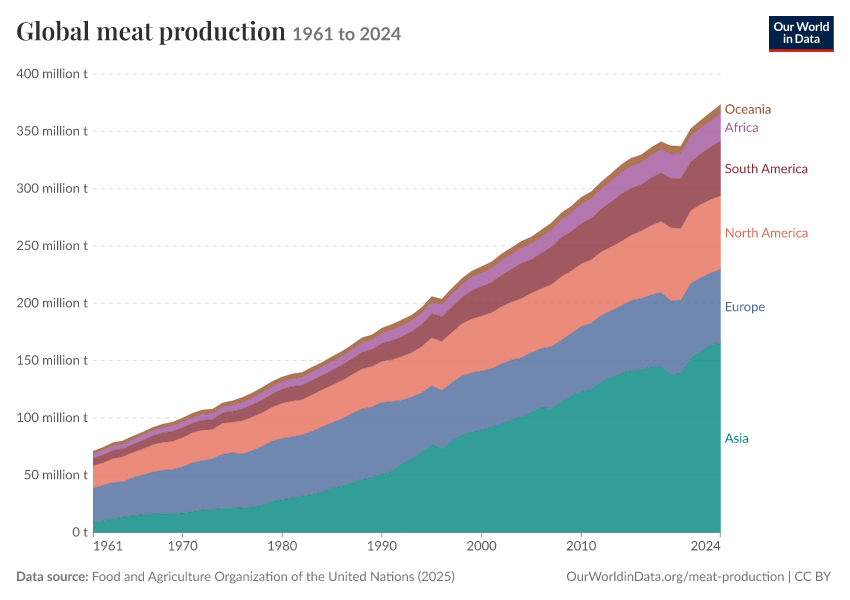
Our World in Data · global meat production · FAO
Fish make up most of the animals we kill
About 88 billion land animals were killed in 2024, and about 78.5 billion of them were chickens, followed by ducks, pigs, sheep, goats, and cows[1]. Far more fish are killed: an estimated 1.1 to 2.2 trillion are caught from the wild every year[2], and fish farms kill about another 130 billion[3].
Read full article →Cows, pigs, hens, and fish are smarter than they get credit for
A mother cow answers her own calf’s voice. Pigs do as well as dogs on many thinking tests, and they can use a mirror to find food. Hens keep track of about 100 flock-mates and get distressed when their chicks are upset[1], and cleaner wrasse, a kind of fish, pass the mirror test[2].
Read full article →The official counts of animals killed are almost certainly too low
The land-animal figures come from the UN’s FAOSTAT database, compiled by Faunalytics[1]. They’re the best global numbers available, and they’re still incomplete: reporting is delayed, some countries are missing, and there’s almost no official count of individual fish[1][2].
Read full article →Articles
We kill about 88 billion land animals a year, and far more fish
About 88 billion land animals were slaughtered in 2024, roughly 241 million a day, and the number is still rising. On top of that, 1.1 to 2.2 trillion wild fish are caught every year, and every one of them was someone.
Read full article →
Scientists say we are not the only conscious animals
In the 2012 Cambridge Declaration on Consciousness, neuroscientists said all mammals and birds have the brain structures that generate consciousness. The 2024 New York Declaration went further, saying there’s at least a realistic possibility of conscious experience in every vertebrate, fish included, which covers every animal we farm on a large scale.
Read full article →
Sources
Papers and datasets. Each card keeps its caveats, including small samples and single-animal cases.
[1]Faunalytics / FAO · Observational
The world slaughtered 87,896,729,120 land animals in 2024
Faunalytics compiled the UN’s FAOSTAT data and counted 87,896,729,120 land animals slaughtered in 2024, up about 1.85% from 2023. The killing is growing faster than the human population.
[2]Our World in Data · Observational
Every day, about 200 million chickens, 3.8 million pigs, and 900,000 cows are slaughtered
Working from FAO data for a single year, Our World in Data found that about 200 million chickens, 3.8 million pigs, and 900,000 cows are slaughtered every day. The authors point out that FAO’s figures may not be fully accurate.
[3]Francis Crick Memorial Conference, 2012 · Review
The Cambridge Declaration says all mammals and birds have the brain systems for consciousness
In 2012, a group of neuroscientists declared that, on the weight of the evidence, humans aren’t the only ones with the brain systems that generate consciousness. All mammals and birds have them too.
[4]NYU, 2024 · Review
The New York Declaration says mammals and birds are likely conscious and fish may be too
The 2024 declaration finds strong support for consciousness in mammals and birds, and at least a realistic possibility of it in all vertebrates, fish included. When that possibility exists, it says, ignoring it is irresponsible.
[5]Animal Welfare, 2024 · Observational
Between 1.1 and 2.2 trillion wild fish are caught every year
Mood and Brooke used FAO catch tonnage to estimate that 1.1–2.2 trillion wild fish were caught each year on average from 2000 to 2019. The estimate leaves out illegal fishing, discards, and ghost fishing. About half of the fish went into fishmeal and fish oil.
[6]Current Biology, 2026
A cow named Veronika uses a broom to scratch herself, the first tool use reported in cows
Veronika preferred the bristled end of a broom but switched to the stick end for the softer areas of her lower body, using one object for different jobs. It’s the first scientific report of tool use in cows. The study covers a single animal, so it shows what a cow can do, not how common it is in herds.
[7]International Journal of Comparative Psychology, 2015
Marino and Colvin reject the idea that pigs are far less intelligent than dogs
Marino and Colvin reviewed the research on pigs and rejected the idea that pigs are “significantly less intelligent than dogs.” Pigs’ memory, ability to tell objects apart, social complexity, and personalities are all well documented.
[8]PNAS, 2024
Chicks who have never seen a face already have brain cells that respond to faces
Researchers recorded single brain cells in one-week-old chicks who had never seen a face. Neurons in a higher-order brain area responded selectively to a standard face-like arrangement, so face perception doesn’t depend only on what chicks learn after hatching.
[9]Science, 2015
Newly hatched chicks have a left-to-right number line like ours
Newly hatched chicks, a few days old, link smaller numbers with the left and larger numbers with the right, a mental number line much like the human one. Simple arithmetic with hidden objects comes from a separate 2009 paper by the same group.
[10]Proceedings of the Royal Society B, 2003
Trout have pain receptors, and acid or venom changes their behavior for hours
Recording nerve activity in rainbow trout, researchers found nociceptors (pain receptors) on the head that respond to several kinds of harmful stimuli, much like those of higher vertebrates. Acid or venom changed the fish’s behavior and physiology for hours.
[11]PLOS Biology, 2019
Cleaner wrasse fish pass the mirror mark test
Kohda and colleagues found that bluestreak cleaner wrasse tried to scrape off a mark they could see only in a mirror, which the researchers read as passing the mark test. A 2022 follow-up, using a mark more relevant to the fish’s natural life, made the result more convincing.
[12]Fishcount / Animal Welfare
About 130 billion farmed fish were killed in 2022
Mood and colleagues at Fishcount estimate that about 130 billion farmed fish were killed worldwide in 2022, within a range of 86–180 billion. Their peer-reviewed estimate for 2019 had a midpoint of 124 billion, a nine-fold rise since 1990. The counts are converted from FAO tonnage using estimated average weights.