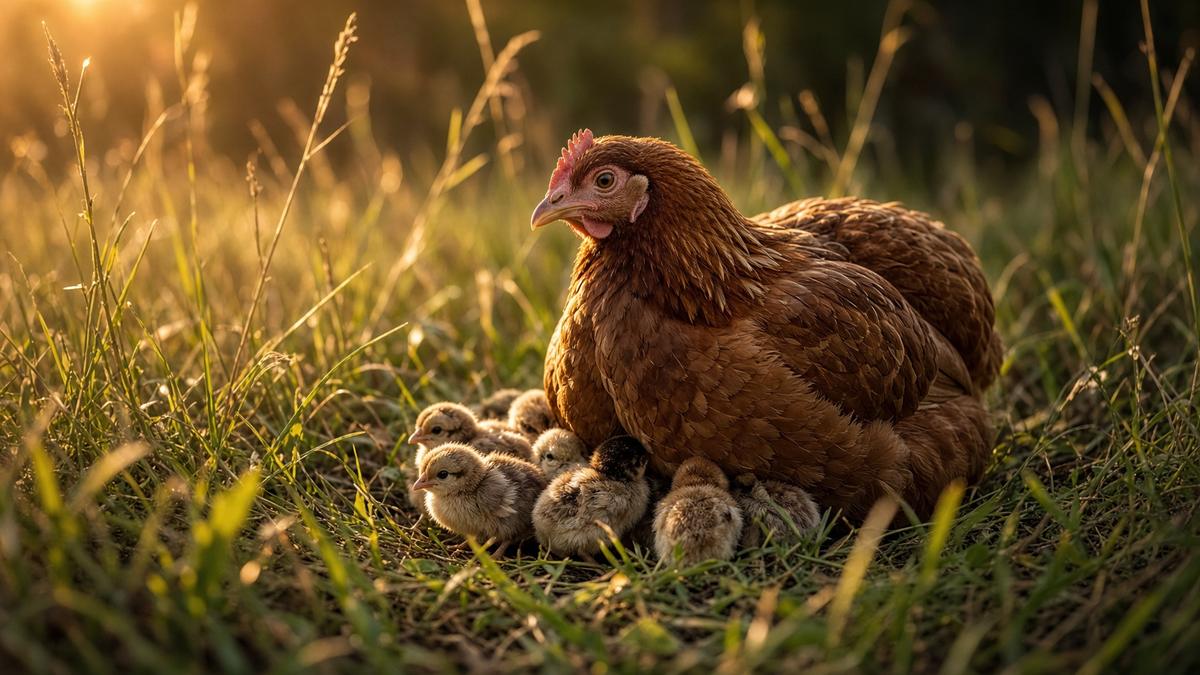
Chickens
Chickens recognize faces, and we kill about 215 million of them a day
78.5BChickens killed in 2024 (FAO)
Chickens are the most killed land animal, about 78.5 billion a year, or nearly 9 out of every 10 land animals slaughtered[6]. Hens can recognize around 100 other birds[1][2] and feel distress when their chicks are hurt[3], and chicks can count within days of hatching[4]. Chickens raised for their flesh are bred to grow so fast they reach slaughter weight in about seven weeks[7], and the egg industry kills about 6 billion male chicks a year right after hatching because they will never lay eggs[9]. They were never ours to begin with.
78.5B
Chickens killed in 2024 (FAO)
About 215 million chickens every day, or 150,000 every minute. No land animal on Earth is killed in greater numbers.
Who they are
The main points first. Every claim is tied to a source below.
Hens can recognize about 100 other birds
Hens know their flock-mates as individuals[1][2]. Early studies put the number they can keep track of at around 100 birds, and later experiments with Y-mazes and slides showed they can tell birds apart just by looking at them[1][2]. Faces matter from the start: chicks that have never seen a face already have brain cells that respond specifically to a face-like arrangement of features[3]. Hens also learn to recognize particular people[1].
Read full article →Mother hens get stressed when their chicks are upset
When researchers gave chicks a mildly unpleasant puff of air, their mothers became more alert, preened less, and dropped in eye temperature, a physical sign of stress, even though nothing was happening to the hens themselves[1]. The researchers called it a building block of empathy[1].
Read full article →Day-old chicks can count
Chicks just a few days old pick the larger of two hidden groups and do simple addition and subtraction with small numbers[1]. They also line numbers up in space the way people do, smaller ones to the left and larger ones to the right[2]. Nobody has to train them: chicks can already do this when they’re a few days old[1][2].
Read full article →Hens will wait for a bigger reward
Hens will wait six seconds for a 22-second jackpot of food instead of taking three seconds right away[1]. Holding out like that, called delay of gratification, takes self-control and some sense of the future[1]. Hens also use logic to work out the pecking order, which scientists call transitive inference: if A beats B and B beats you, you don’t pick a fight with A[1].
Read full article →The egg industry kills billions of male chicks a year
Hens used for eggs come from a different supply chain than chickens raised for their flesh, and it’s no kinder. The male chicks of egg-laying breeds don’t lay eggs and aren’t the fast-growing breeds raised for flesh, so the industry has no use for them: roughly 6 billion a year worldwide are ground up or gassed shortly after hatching[2]. The hens who do lay are killed once their egg production drops[2].
Read full article →Chickens raised for flesh are now slaughtered at about 47 days old, down from more than 100
In 1925, a chicken raised for flesh was slaughtered at about 112 days old, weighing about 2.5 pounds[1]. Today, the National Chicken Council’s own figures put slaughter age at around 47 days, at more than 6 pounds[1]. That growth rate comes from selective breeding, not nature: the industry redesigned the bird for speed[1].
Read full article →Articles
Chickens recognize faces and count, and we kill 215 million a day
About 78.5 billion chickens were killed in 2024, bred to reach slaughter weight in about 47 days, and the egg industry kills billions of male chicks right after they hatch. Hens can tell about 100 flock-mates apart, react when their chicks are in distress and wait for a bigger reward, and chicks only days old can do simple arithmetic.
Read full article →
Sources
Papers and datasets. Each card keeps its caveats, including small samples and single-animal cases.
[1]Animal Cognition, 2017 · Review
Chickens recognize each other, track rank, and sense time, Marino’s review finds
Marino’s review found that chickens recognize individuals, both live and in slides, keep social hierarchies and track who ranks where, can make simple social inferences, and perceive time. They aren’t the simple-minded animals they’re sold as.
[2]Behavioural Processes, 1991 · Small sample
Hens can tell the members of their flock apart
In Bradshaw’s study, hens in a Y-shaped maze learned to tell members of their own social group apart to get food. So they recognize individual birds, not just a generic “chicken.”
[3]Proceedings of the Royal Society B, 2011 · Observational
Mother hens show stress when their chicks are in distress
When their chicks were exposed to something mildly unpleasant, mother hens became more alert, preened less, and their eye temperature dropped. Being affected by another’s state is a core part of empathy.
[4]Science, 2015 · Observational
Newly hatched chicks have a left-to-right number line like ours
Newly hatched chicks, a few days old, link smaller numbers with the left and larger numbers with the right, a mental number line much like the human one. Simple arithmetic with hidden objects comes from a separate 2009 paper by the same group.
[5]PubMed · Observational
Eating over 300 g of chicken and turkey flesh a week was linked with a higher risk of death
In a competing-risk analysis, eating more than 300 g of chicken and turkey flesh a week was linked with higher death rates from all causes and from gastrointestinal cancers. The study is about human health and is separate from the question of sentience.
[6]Faunalytics / FAO · Observational
About 78.5 billion chickens were slaughtered in 2024
According to FAOSTAT, about 78.5 billion chickens were slaughtered in 2024, up from 76.2 billion in 2023, out of the 87.9 billion land animals Faunalytics counted that year. Most of the land animals killed are chickens.
[7]National Chicken Council · Observational
Chickens raised for flesh are now slaughtered at about 47 days old, down from about 112 in 1925
According to the National Chicken Council, a chicken raised for flesh in 1925 took about 112 days to reach market and weighed about 2.5 pounds. Recent figures put market age around 47 days, at more than 6 pounds. The birds were bred to grow fast, not to live the life of a chicken.
[8]PNAS, 2024 · Observational
Chicks who have never seen a face already have brain cells that respond to faces
Researchers recorded single brain cells in one-week-old chicks who had never seen a face. Neurons in a higher-order brain area responded selectively to a standard face-like arrangement, so face perception doesn’t depend only on what chicks learn after hatching.
[9]Vox, 2023
The egg industry kills about 6.5 billion male chicks a year
Vox reports that the egg industry hatches about 6.5 billion male chicks a year and kills them shortly after, usually by grinding them up or gassing them. The males lay no eggs and grow too slowly to be worth selling for their flesh.