Fish
The most killed animals on the planet
1.1–2.2TWild fish caught per year
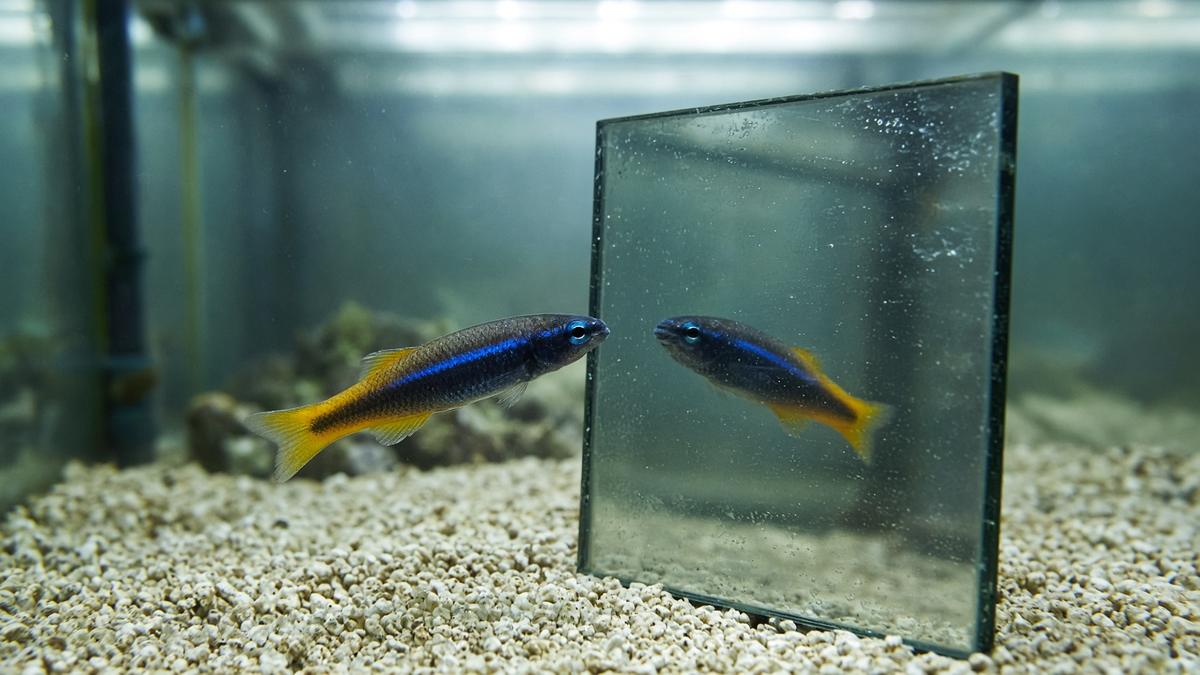
Over a trillion fish are killed every year, far more than all land animals combined[1][2], and about half the wild catch is ground into feed for other farmed animals[1]. Fish feel pain, and painkillers relieve it[4][8]. Some even recognize themselves in a mirror[6] and use tools[10]. Scientists now say fish may well be conscious[7]. Calling them “just fish” is how the largest killing on the planet stays easy to ignore.
1.1–2.2T
Wild fishes caught per year (recorded catch)
A midpoint of ~1.6 trillion works out to about 4 billion wild fishes every day, plus ~130 billion farmed finfish a year. No killing on the planet is larger.
Who they are
The main points first. Every claim is tied to a source below.
We kill far more fish than all land animals combined
Chickens are the land animals we kill most, at about 78.5 billion, and farmed fish already outnumber them: about 130 billion were killed in 2022, within a range of 86–180 billion[2]. The wild catch is bigger by another order of magnitude[1][2], at 1.1 to 2.2 trillion individual fish in the recorded catch each year[1]. The UN’s Food and Agriculture Organization (FAO) still reports fish by weight instead of counting individuals[1][2], which is one reason the number has been so easy to miss.
Read full article →Fish have pain receptors, and painkillers work on them
Lynne Sneddon’s research on rainbow trout found pain receptors on their heads, called polymodal nociceptors, that respond to pressure, heat, and acid, the same types described in mammals[1]. Trout injected with bee venom or acid rocked from side to side, breathed faster, and stopped eating, and morphine reduced those reactions, which a simple reflex can’t explain[2]. Reviews over the last decade conclude that bony fish meet the standard criteria for pain in animals[3].
Read full article →Some fish pass the mirror test
Bluestreak cleaner wrasse scrape a mark off their throats when they can see it in a mirror, but not when the mark is clear or there’s no mirror[1]. They recognize their own face in photos[2]. Some pick up shrimp and drop it in front of the mirror to watch how the reflection moves, testing the mirror itself[3]. More recent work found they use the mirror to check their own size before deciding whether to fight[4]. Outside mammals and birds, few animals have stronger experimental evidence that they recognize themselves in a mirror[1][2][3].
Read full article →Fish use tools
Tuskfish and wrasses smash shellfish open on rocks, using them as anvils[1]. Archerfish shoot jets of water to knock insects down, a skill they learn, partly by watching other archerfish[2]. Groupers and moray eels even signal to each other when they hunt together[2].
Read full article →About half of wild-caught fish are turned into fishmeal and oil
Mood and Brooke estimate that around half of the wild fish in the recorded catch, hundreds of billions of mostly small fish, are turned into fishmeal and oil[1]. Much of that is fed to farmed animals, including farmed fish[1]. So eating farmed salmon doesn’t spare wild fish, because wild fish go into the feed.
Read full article →Most wild-caught fish are crushed or suffocated
Most wild-caught fish die in nets or on deck, crushed or suffocated[2]. Many farmed fish are killed by being left in the air or put in ice slurry[2]. When there’s a real chance an animal can experience what happens to it, ignoring that is hard to justify[1], and since fish are vertebrates, that chance applies to them[1].
Read full article →Articles
Fish feel pain, and we kill more than a trillion of them a year
We catch an estimated 1.1 to 2.2 trillion wild fish every year and kill about 130 billion more on fish farms. Fish have pain receptors much like ours, painkillers reduce their pain behavior, some recognize themselves in a mirror, and some use tools.
Read full article →
Sources
Papers and datasets. Each card keeps its caveats, including small samples and single-animal cases.
[1]Animal Welfare, 2024 · Observational
In 2019, wild-caught fish were about 87% of the vertebrates killed for food or feed
From recorded FAO landings, the authors estimate that 1.1–2.2 trillion wild fish were caught each year on average between 2000 and 2019. In 2019 alone it was 980–1,900 billion, still about 87% of all vertebrates killed for food or feed. The count leaves out illegal fishing, discards, and ghost fishing, and the authors want FAO to report how many fish are caught, not just their weight.
[2]Fishcount / Animal Welfare · Observational
About 130 billion farmed fish were killed in 2022
Mood and colleagues at Fishcount estimate that about 130 billion farmed fish were killed worldwide in 2022, within a range of 86–180 billion. Their peer-reviewed estimate for 2019 had a midpoint of 124 billion, a nine-fold rise since 1990. The counts are converted from FAO tonnage using estimated average weights.
[3]Animal Welfare, 2023 · Observational
Between 78 and 171 billion farmed fish were killed for food in 2019
The authors’ peer-reviewed estimate for 2019 was 78–171 billion farmed fish killed, with a midpoint of 124 billion. Pond loach, Nile tilapia, and carp make up the biggest share of the count.
[4]Proceedings of the Royal Society B, 2003 · Observational
Trout have pain receptors, and acid or venom changes their behavior for hours
Recording nerve activity in rainbow trout, researchers found nociceptors (pain receptors) on the head that respond to several kinds of harmful stimuli, much like those of higher vertebrates. Acid or venom changed the fish’s behavior and physiology for hours.
[5]Animal Cognition, 2015 · Review
Fish often match or beat other vertebrates in perception and cognition, Culum Brown finds
Culum Brown’s review found that fish often match or exceed other vertebrates in perception and cognition, with evidence for pain, social intelligence, long-term memory, and tool use. Public understanding of fish is decades behind the science.
[6]PLOS Biology, 2019 · Small sample
Cleaner wrasse fish pass the mirror mark test
Kohda and colleagues found that bluestreak cleaner wrasse tried to scrape off a mark they could see only in a mirror, which the researchers read as passing the mark test. A 2022 follow-up, using a mark more relevant to the fish’s natural life, made the result more convincing.
[7]NYU, 2024 · Review
The New York Declaration says mammals and birds are likely conscious and fish may be too
Based on the evidence, the declaration finds at least a realistic possibility of conscious experience in all vertebrates, including fish. When that possibility exists, it says, it’s irresponsible to ignore it in decisions that affect them.
[8]Applied Animal Behaviour Science, 2003 · Observational
Morphine reduces pain behavior in trout
Acid or venom in the lip changed trout behavior and breathing, and morphine significantly reduced those pain-related behaviors. The authors concluded that the responses weren’t simple reflexes.
[9]Scientific Reports, 2025 · Small sample
Some cleaner wrasse recognized themselves in a mirror within hours
Cleaner wrasse passed the mirror mark test quickly, in some cases within their first hours in front of a mirror. Some then dropped shrimp by the mirror to watch the reflection move, a way of checking that the reflection follows their own actions.
[10]Coral Reefs, 2012 · Small sample
A tuskfish was filmed using a rock as an anvil to smash a shellfish
A tuskfish (Choerodon schoenleinii), a kind of wrasse, was filmed smashing a bivalve shellfish against a rock it used as an anvil. Few people imagine fish using tools, but scientists have documented it.