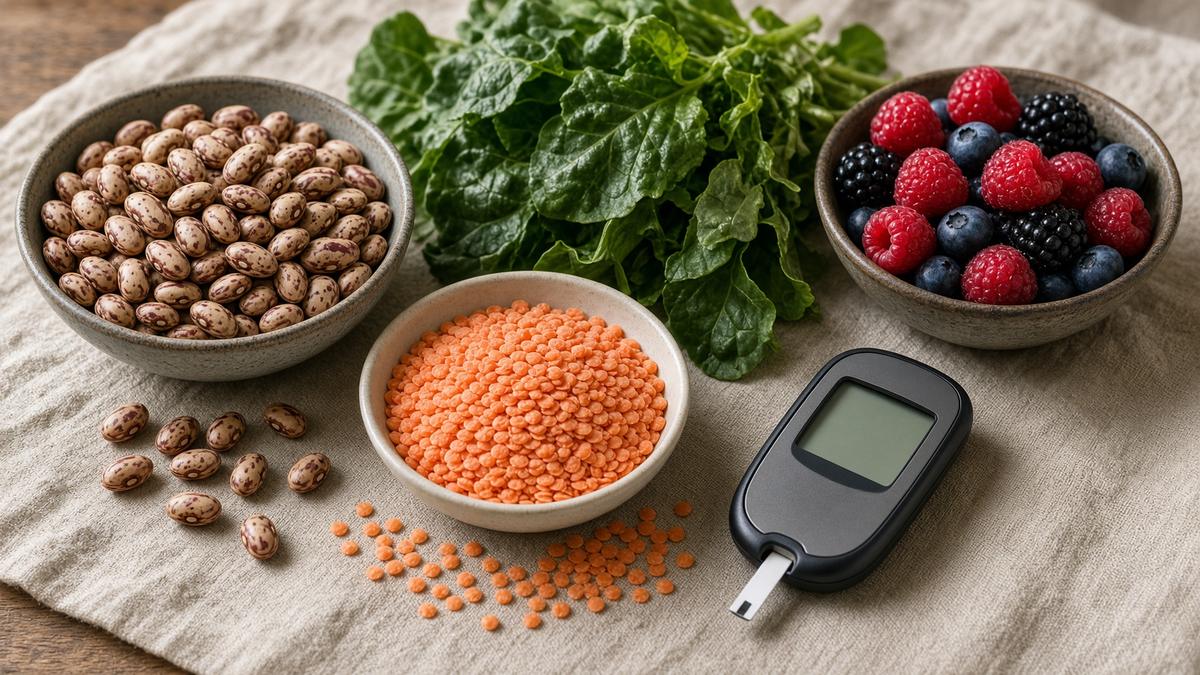
Diabetes
Vegans have the lowest risk of type 2 diabetes, and the more meat people eat, the higher it goes
DoseMore meat, higher type 2 diabetes risk
Vegans have the lowest risk of type 2 diabetes[1][4], and the rate was more than 2.5 times higher in meat-eaters than in vegans[13]. Eating meat, even unprocessed red meat, raises the risk[7]. Vegan diets can also treat the disease, lowering blood sugar and letting many people cut back on their medication[14][17]. People with type 1 diabetes needed about 28% less insulin on a vegan diet[9]. If you cared about diabetes, you would stop eating animals.
What the evidence says
The main points first. Every claim is tied to a source below.
Vegans have the lowest risk of type 2 diabetes
In the Adventist Health Study-2 and other research on vegetarian diets, vegans have the lowest rates of type 2 diabetes[1][2][3]. Among the Adventists, vegans had less diabetes than both vegetarians and meat eaters, in a population where people otherwise live much alike[1].
Read full article →The more meat people eat, the higher their type 2 diabetes risk
Meta-analyses find that type 2 diabetes risk rises with how much meat people eat, whether it’s total meat[1], red meat[1][5], unprocessed red meat[2], or processed meat[1][2][5]. In 1.97 million adults, every 100 g of unprocessed red meat a day came with 10% more type 2 diabetes[6]. Across 12 cohorts, people eating the most red meat had 21% more type 2 diabetes than those eating the least, and for processed meat it was 41% more[4]. Among Adventists, diabetes rates climbed step by step with animal foods, from 2.9% in vegans to 7.6% in non-vegetarians[7]. In Satija’s study of 200,727 people, those who scored highest on healthy plant-based eating had 34% less diabetes, while an unhealthy plant-based diet heavy in juice, soda, refined grains, and sweets raised the risk[8]. One analysis of 12 food groups did find dairy linked with lower diabetes risk[5], unlike the other findings.
Read full article →Plant-based diets lowered blood sugar in trials, and some people fell below the diabetes threshold
In a randomized trial, 43% of people on a low-fat vegan diet cut back their diabetes medication, compared with 26% on the American Diabetes Association diet[1]. Among those whose medication stayed the same, HbA1c, a measure of long-term blood sugar, fell 1.23 points on the vegan diet versus 0.38, and weight fell 6.5 kg versus 3.1 kg[1]. The vegan group was still ahead at 74 weeks, with HbA1c down 0.40 versus 0.01 before medication changes[2]. In six controlled trials with 255 people, vegetarian diets lowered HbA1c by 0.39 points[3]. Across 11 trials, plant-based diets beat official diabetes-association guidelines on HbA1c, weight, cholesterol, and mood[4]. In the BROAD community trial, some people’s blood sugar fell below the threshold for diagnosing diabetes[5]. At ten workplaces, 18 weeks of a low-fat vegan diet with no calorie limits lowered HbA1c by 0.6 points in people with diabetes[6]. And in people who already have diabetes, swapping animal protein for plant protein modestly improved HbA1c, fasting glucose, and fasting insulin[7].
Read full article →A vegan diet cut insulin needs in type 1 diabetes, and childhood cow’s milk is linked with getting it
In a randomized trial of adults with type 1 diabetes, a vegan diet cut daily insulin use by 28% and insulin costs by 27%, with no rise in episodes of low or high blood sugar[2]. Cow’s milk, on the other hand, is linked with getting type 1 diabetes in the first place: a meta-analysis of 96 studies found that children who drank 2–3 or more glasses a day had 1.8 times the risk[3]. In the DAISY study, children who got more cow’s milk protein had more islet autoimmunity, the immune system attacking the cells that make insulin, and progressed to type 1 diabetes faster[4].
Read full article →Articles
Vegans have the lowest risk of type 2 diabetes
Vegans get type 2 diabetes less often than any other diet group, and the more meat people eat, the higher their risk, even when the meat is unprocessed red meat or the flesh of chickens and turkeys.
Read full article →
Vegan diets can turn type 2 diabetes around
In randomized trials, people with type 2 diabetes on vegan diets cut their medication, lowered their blood sugar more than on the standard diabetes diets, and some no longer met the threshold for a diagnosis. In type 1 diabetes, a vegan diet cut how much insulin people needed.
Read full article →
Sources
Papers and datasets. Each card keeps its caveats, including small samples and single-animal cases.
[1]PMC · Observational
Vegan diets came with the fewest new cases of type 2 diabetes
Of the diets studied, vegan diets were linked with the lowest rate of new type 2 diabetes cases.
[2]PubMed · Observational
Vegan participants had the lowest type 2 diabetes risk
Among all the participants, the vegans had the lowest risk of diabetes.
[3]PubMed · Meta-analysis
The more meat people ate, the higher their type 2 diabetes risk
Type 2 diabetes risk rose in a straight line with how much total meat, red meat, and processed meat people ate.
[4]American Journal of Epidemiology · Observational
Vegans had the lowest diabetes risk of any diet group in the Adventist Health Study-2
Among Adventists, vegans had the lowest risk of developing diabetes of all the diet groups.
[5]PMC · Review
Eating meat is consistently linked with type 2 diabetes
Studies consistently link eating meat with a higher risk of diabetes.
[6]PubMed · Meta-analysis
Processed and unprocessed red meat both come with more cardiovascular disease and diabetes
This systematic review found that both unprocessed and processed red meat are linked with a higher risk of cardiovascular disease and diabetes.
[7]The Lancet Diabetes & Endocrinology, 2024 · Meta-analysis
Red meat, processed meat, and chicken and turkey flesh all came with more diabetes
Across 1.97 million adults in 31 cohorts from 20 countries, each 100 g a day of unprocessed red meat came with 10% more type 2 diabetes, each 50 g a day of processed meat with 15% more, and each 100 g a day of chicken and turkey flesh with 8% more.
[8]Clinical Diabetes, 2024 · Clinical
People with type 1 diabetes needed less insulin on a low-fat vegan diet
In a 12-week randomized trial, adults with type 1 diabetes on a low-fat vegan diet needed less insulin and became more sensitive to it, while a portion-controlled comparison group didn’t change.
[9]BMC Nutrition, 2025 · Clinical
A vegan diet cut daily insulin use by 28% and insulin costs by 27%
In the same trial, daily insulin use fell 28% and insulin costs 27% in the vegan group, with no rise in low or high blood sugar (hypoglycemia or hyperglycemia).
[10]EBioMedicine, 2021 · Meta-analysis
Children drinking 2–3 or more glasses of cow’s milk a day had 1.8 times the type 1 diabetes risk
In a meta-analysis of 96 studies on diet and type 1 diabetes, children who drank 2–3 or more glasses of cow’s milk a day had 1.8 times the risk. Starting cow’s milk later came with lower risk.
[11]Diabetes Autoimmunity Study in the Young / PMC · Observational
Children who got more cow’s milk protein progressed faster to type 1 diabetes
In the DAISY study, which followed 1,835 children from infancy, more cow’s milk protein came with more islet autoimmunity (an immune attack on the cells that make insulin) and faster progression to type 1 diabetes.
[12]PLOS Medicine, 2016 · Observational
A healthy plant-based diet came with 34% less type 2 diabetes in 200,727 people
Across the Nurses’ Health Studies and the Health Professionals Follow-Up Study, with 200,727 people and two decades of diet records, the most plant-based eaters had 20% less type 2 diabetes, and those highest on the healthy version of the score had 34% less. The unhealthy version, heavy on juice, soda, refined grains, and sweets, came with higher risk instead.
[13]Diabetes Care, 2009 · Observational
Type 2 diabetes went from 2.9% in vegans to 7.6% in non-vegetarians among Adventists
Among 60,903 Adventists, type 2 diabetes rates climbed step by step with the amount of animal food in the diet, from 2.9% in vegans to 3.2% in lacto-ovo vegetarians, 4.8% in pesco-vegetarians, 6.1% in semi-vegetarians, and 7.6% in non-vegetarians. Vegans still had about half the risk after adjusting for body mass index.
[14]Diabetes Care, 2006 · Clinical
A low-fat vegan diet beat the standard diabetes diet in a 22-week trial
In a 22-week randomized trial, 43% of the low-fat vegan group cut their diabetes medication, compared with 26% on the American Diabetes Association diet. Among people whose medication stayed the same, HbA1c fell 1.23 points on the vegan diet versus 0.38, and weight fell 6.5 kg versus 3.1 kg.
[15]American Journal of Clinical Nutrition, 2009 · Clinical
At 74 weeks, the vegan diet still beat the conventional diabetes diet on blood sugar
Over 74 weeks, about a year and a half, the vegan diet kept its advantage. Before any medication changes, HbA1c fell 0.40 on the vegan diet versus 0.01 on the conventional diet, with bigger drops in total and LDL cholesterol. By then, though, weight loss no longer differed significantly between the groups.
[16]Cardiovascular Diagnosis and Therapy, 2014 · Meta-analysis
Vegetarian diets lowered long-term blood sugar (HbA1c) in six trials
Across six controlled trials with 255 people, vegetarian diets lowered HbA1c, a measure of long-term blood sugar, by 0.39 percentage points compared with the diets they were tested against. Fasting glucose also fell, but not by a significant amount.
[17]BMJ Open Diabetes Research & Care, 2018 · Review
Plant-based diets beat standard diets for type 2 diabetes in 11 trials
Across 11 controlled trials in 433 people with type 2 diabetes, plant-based diets did better than diets based on official diabetes-association guidelines and other comparison diets on HbA1c, weight, and cholesterol. They also did better on depression, quality of life, and general well-being.
[18]Nutrition & Diabetes, 2017 · Clinical
On a plant-based diet with no calorie counting, BROAD trial participants lost about 12 kg
The BROAD trial randomized people with obesity, ischemic heart disease, or type 2 diabetes, and the group on a whole-food plant-based diet didn’t count calories. After 6 months, they had lost about 12 kg, their BMI and cholesterol had improved, and their HbA1c had fallen. Two people with diabetes no longer met the threshold for a diagnosis.
[19]Diabetologia, 2009 · Meta-analysis
Red and processed meat were linked with more type 2 diabetes in 12 cohorts
In a pooled analysis of 12 cohort studies, people who ate the most red meat had 21% more type 2 diabetes than those who ate the least, and people who ate the most processed meat had 41% more.
[20]European Journal of Epidemiology, 2017 · Meta-analysis
In a review of 12 food groups, red and processed meat were linked with more diabetes
Red meat, processed meat, and sugary drinks were linked with a higher risk of type 2 diabetes, and the evidence for the meats was graded ‘high’. Eating optimal amounts of the protective foods was linked with 42% lower risk. Whole grains and fruit were protective, and in this analysis dairy was too.
[21]European Journal of Clinical Nutrition, 2013 · Clinical
Employees on a low-fat vegan diet lost weight and lowered cholesterol in 18 weeks
Employees at ten corporate sites were randomly assigned to a low-fat vegan diet with no calorie limits or to a control group. Over 18 weeks, the vegan group lost 2.9 kg while the controls held steady, their total and LDL cholesterol fell by about 8 mg/dL, and those with diabetes lowered their HbA1c by 0.6 points.
[22]Nutrients, 2015 · Meta-analysis
Replacing animal protein with plant protein improved blood sugar in diabetes
In randomized trials of people with diabetes, replacing animal protein with plant protein modestly improved HbA1c, fasting glucose, and fasting insulin. The authors say longer and larger trials are needed.