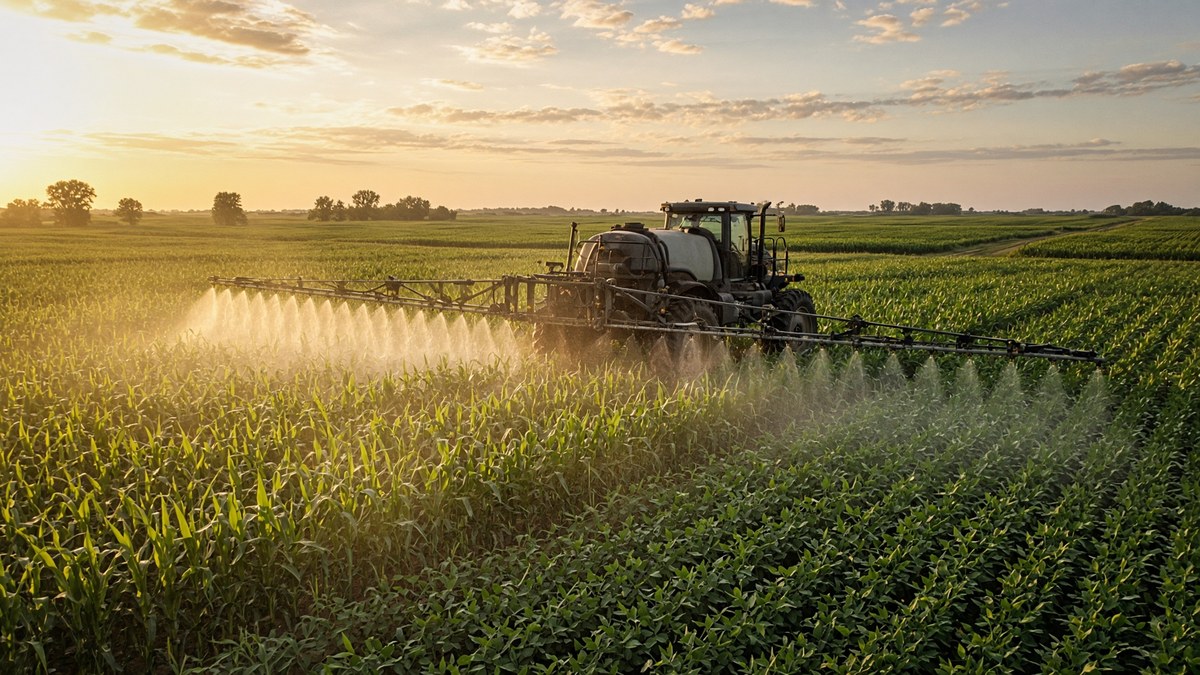
Pesticides
If you cared about pesticides, you would stop eating farm animals.
2,000×legal glyphosate limit on animal feed vs many human foods
Under the EPA’s glyphosate residue tolerances in 40 CFR 180.364, nongrass animal feed may carry 400 parts per million of glyphosate[1], while many human foods, such as leafy vegetables and stone fruit, are capped at 0.2 parts per million[1]. That lets animal feed carry 2,000× more[1]. About 80% of all our agricultural land is for farm animals[4], so much of our pesticide use goes to growing their feed[2][3].
Corn and soy alone take about half of U.S. pesticide spraying[3], and most of those crops are grown to feed farm animals, not people[3]. One count puts it at about 235 million pounds of herbicides and insecticides sprayed in the U.S. in 2018 just for animal feed[2]. If you cared about insects, or about spraying, you would stop eating animals.
What the evidence says
The main points first. Every claim is tied to a source below.
The legal glyphosate limit on animal feed is 2,000 times higher
EPA’s own glyphosate table, 40 CFR 180.364, sets animal feed, nongrass, group 18 at 400 parts per million[1]. Many human foods on that same table, including artichoke, stone fruit, and leafy vegetables, are at 0.2[1].
400 divided by 0.2 is 2,000[1], so the crops grown to fatten farm animals are allowed two thousand times more of this pesticide than crops for human food[1].
This is the official U.S. residue limit[1], not a campaign estimate. If the concern is how much poison is allowed on food, look at the feed.
Read full article →Most of the spraying is for farm animals, not your salad
Corn and soy take about half of U.S. pesticide use[2], and most of that harvest never becomes anyone’s dinner[2]. Globally, about 80% of soy[3] and about 61% of corn is farm-animal feed; in the U.S., most soy and about a third of corn go the same way.
World Animal Protection and the Center for Biological Diversity counted about 235 million pounds of herbicides and insecticides on U.S. factory-farm feed crops in 2018[1], including about 100 million pounds of glyphosate[1].
Eating the animal means growing the feed crop first and then losing most of it in conversion, and the spraying happens on those extra acres.
Read full article →About 80% of agricultural land is for farm animals
Poore and Nemecek found that farm animals use about 80% of agricultural land[1] while supplying a minority of calories. Feed crops take about 75% of U.S. cropland[2].
So “I care about pesticides, so I worry about vegetables” gets the map backwards. The acres sprayed at industrial scale are corn, soy, and hay for farm animals. A vegan diet drops that land, and the spraying goes with it[2].
Read full article →If you cared about insects, you would stop eating farm animals
Glyphosate on Midwest corn and soy wiped milkweed out of those fields, and that loss is a main driver of the monarch decline[1]. EPA’s own evaluation says glyphosate is likely to hurt a large majority of the protected species it studied, including plants, insects, fish, and others[2].
Those corn and soy fields exist at this scale because farm animals eat what they grow. A plate of plants needs a fraction of the land, and so a fraction of the spray. If insects are the reason you hesitate, the feedlot is the bigger insecticide.
Read full article →Articles
Most pesticide spraying is for farm-animal feed
Corn and soy take about half of U.S. pesticide use, and most of that harvest feeds farm animals. EPA rules even let nongrass animal feed carry 2,000 times more glyphosate than many human foods.
Read full article →
Sources
Papers and datasets. Each card keeps its caveats, including small samples and single-animal cases.
[1]eCFR / 40 CFR 180.364 · Review
40 CFR 180.364 — Glyphosate tolerances
EPA glyphosate residue limits: animal feed, nongrass, group 18 is 400 ppm, while artichoke, many fruits, leafy vegetables, and other human foods are 0.2 ppm. 400 divided by 0.2 is 2,000.
[2]Center for Biological Diversity / World Animal Protection, 2022 · Review
Collateral Damage — pesticides on factory-farm feed
World Animal Protection US and the Center for Biological Diversity: about 235 million pounds of herbicides and insecticides were applied to U.S. feed crops for factory-farmed animals in 2018, including about 100 million pounds of glyphosate.
[3]Faunalytics, 2023 · Review
Pesticides in farmed animal feed
Faunalytics summary: corn and soy make up a large share of U.S. pesticide use, with about 49% of pesticides applied to those two crops alone, and most of that harvest is feed.
[4]Science, 2018 · Meta-analysis
Poore & Nemecek — farm animals take most farmland
Farm animals use about 80% of agricultural land while supplying a minority of calories. A worldwide vegan diet would shrink farmland from about 4.1 to about 1 billion hectares.
[5]WWF · Review
WWF — most soy is farm-animal feed
About 80% of global soy production is used as farm-animal feed, not eaten by people.
[6]U.S. EPA · Review
EPA biological evaluation — glyphosate and listed species
EPA’s national-level evaluation found glyphosate is likely to adversely affect a large majority of listed species studied, including plants, insects, fish, and other wildlife.
[7]Environmental Research Letters, 2017 · Observational
Thogmartin et al. — monarchs and Midwest herbicide
Loss of milkweed in Midwestern farm fields, driven in large part by glyphosate on corn and soy, is a major factor in the monarch butterfly decline.
[8]PNAS, 2018 · Review
White & Hall — U.S. cropland as feed
Feed crops take up roughly 75% of U.S. cropland. Without farm animals, most of that land would not need to be planted and sprayed as feed.