Deforestation
Forests are cut down for cow pasture and feed
~80%Of Amazon deforestation tied to cow ranching
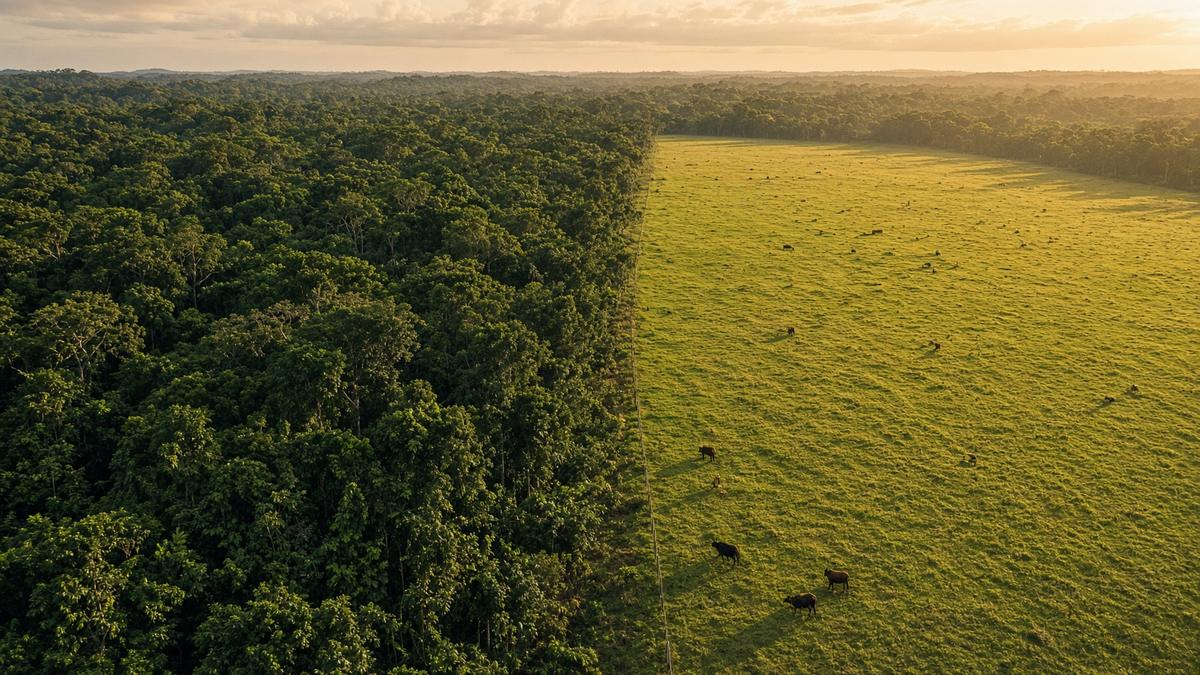
About 80% of the world’s farmland already goes to farm animals and their feed[7], and forests are still being cleared for more[2]. Cow ranching causes about 80% of Amazon deforestation[1], and about 80% of Amazon soy is fed to farm animals[4]. In the tropics, where most forest is cleared, beef alone drives about 41% of deforestation, more than any other product[2], while plant burgers use 93% less land and 99% less water[8]. If you cared about forests, you would stop eating animals.
What the evidence says
The main points first. Every claim is tied to a source below.
80% of farmland already grows feed, and forests are still cut for more
Farm animals have to eat and drink, so we have to grow food for them. About 80% of our agriculture already goes to animal feed[1], and since the land we farm still isn’t enough, forests are burned down to grow more[2][3]. Around a million species are now at risk of extinction[4], and whole ecosystems are destroyed for good, needlessly replaced with farm animals and their feed. Most of our land, water, crops, and other resources go to feeding farm animals, when it’s infinitely more efficient to eat plants directly.
Read full article →
Our World in Data · What are the drivers of deforestation?
About 80% of Amazon deforestation comes from ranching cows
WWF calls extensive ranching of cows the number one cause of deforestation in almost every Amazon country, responsible for about 80% of the deforestation happening now[1]. Yale’s forest researchers have used the same figure. The chainsaws are clearing forest for pasture[1]. The animals have to eat, and the forest is where the extra grazing land and feed come from.
Read full article →Soy in the Amazon is mostly animal feed
In the Amazon, cow ranching and soy go hand in hand[1][3]. According to Yale’s Global Forest Atlas, about 80% of Amazon soy is fed to farm animals, not eaten by people[1]. Add the pasture for cows to the soy grown for feed, and animal farming is why most of that forest is gone[1].
Read full article →Globally, the greed for cow flesh is the largest driver of forest loss
Our World in Data and the World Resources Institute show that pasture for cows has replaced far more forest than oil palm, soy, cocoa, or rubber[1][2]. Pendrill and colleagues put cow flesh at about 41% of tropical deforestation, the largest share of any commodity, in the tropics where most forest is cleared[1]. The Amazon is the famous case, but far from the only one[1]. Forests are being lost to the inhumane and needless greed to eat cow flesh, when there are vegan substitutes that taste the same and use 90%+ less resources and water[3].
Read full article →
Our World in Data · if the world ate plants
A vegan world would free land the size of a continent
If the whole world switched to eating plants, farmland would shrink by about 75%, from about 4.1 billion hectares to about 1 billion[1][2]. The land we’d stop using is pasture and fields of feed crops, and forest could grow back there.
Read full article →Articles
Forests are cleared mainly for cows and their feed
Cow ranching causes about 80% of the deforestation happening in the Amazon today, and about 80% of Amazon soy is fed to farm animals. Worldwide, raising cows is behind more commodity-driven forest loss than any other product.
Read full article →
Sources
Papers and datasets. Each card keeps its caveats, including small samples and single-animal cases.
[1]WWF · Review
Cow ranching causes 80% of current deforestation in the Amazon
WWF says extensive cow ranching is the number one cause of deforestation in nearly every Amazon country, and it accounts for 80% of current deforestation.
[2]Our World in Data · Review
Cow flesh drives more deforestation than any other commodity
Our World in Data, drawing on Pendrill and colleagues, shows that pasture for cows drove about 41% of tropical deforestation. About 95% of forest loss is in the tropics, so beef is the biggest single driver where most forest is cleared. Pasture for cows replaced far more forest than palm oil or soy did.
[3]World Resources Institute · Observational
Cow pasture took up five times as much cleared forest as any other commodity
The World Resources Institute found that pasture for cows took up about 45 million hectares of land deforested between 2001 and 2015, which was 36% of the farming-linked tree-cover loss in its analysis and five times as much as any other commodity it studied.
[4]Yale Global Forest Atlas via reporting · Review
About 80% of Amazon soy is fed to farm animals
News reports citing Yale’s Global Forest Atlas say about 80% of Amazon soy is eaten by farm animals. Cows, and the soy grown to feed them, are behind most of the forest cleared in the Amazon.
[5]Mongabay · Review
Soy and cow ranching are the two biggest drivers of deforestation in Brazil’s Amazon
Mongabay reports that soy farming and cow ranching are the two biggest drivers of deforestation in the Brazilian Amazon. Since 1985, pastures and croplands have replaced tens of millions of hectares of forest and savanna.
[6]Science, 2018 · Meta-analysis
A plant-based world would free about 75% of farmland, mostly pasture
Poore and Nemecek found that a global plant-based diet would cut the land used for farming by about 75%. Most of the land freed up would be pasture.
[7]Our World in Data
About 80% of the world’s farmland is used for meat and dairy
About 80% of the world’s agricultural land is used for meat and dairy, counting both pasture and the land that grows feed crops.
[8]University of Michigan CSS, 2018
A Beyond Burger uses 99% less water and 93% less land than a cow-flesh burger
Heller and Keoleian at the University of Michigan found that a 1/4 lb Beyond Burger uses 99% less water, 93% less land, and 46% less energy than a 1/4 lb U.S. cow-flesh burger, and produces 90% fewer greenhouse gases. The cow-flesh burger consumes 437.7 liters of water and the Beyond Burger 3.27 liters, or 218.4 versus 1.1 liter-equivalents once weighted for water scarcity.