Indigenous
The Three Sisters fed this continent, not cows
1493Cows, pigs, and chickens arrive with Columbus
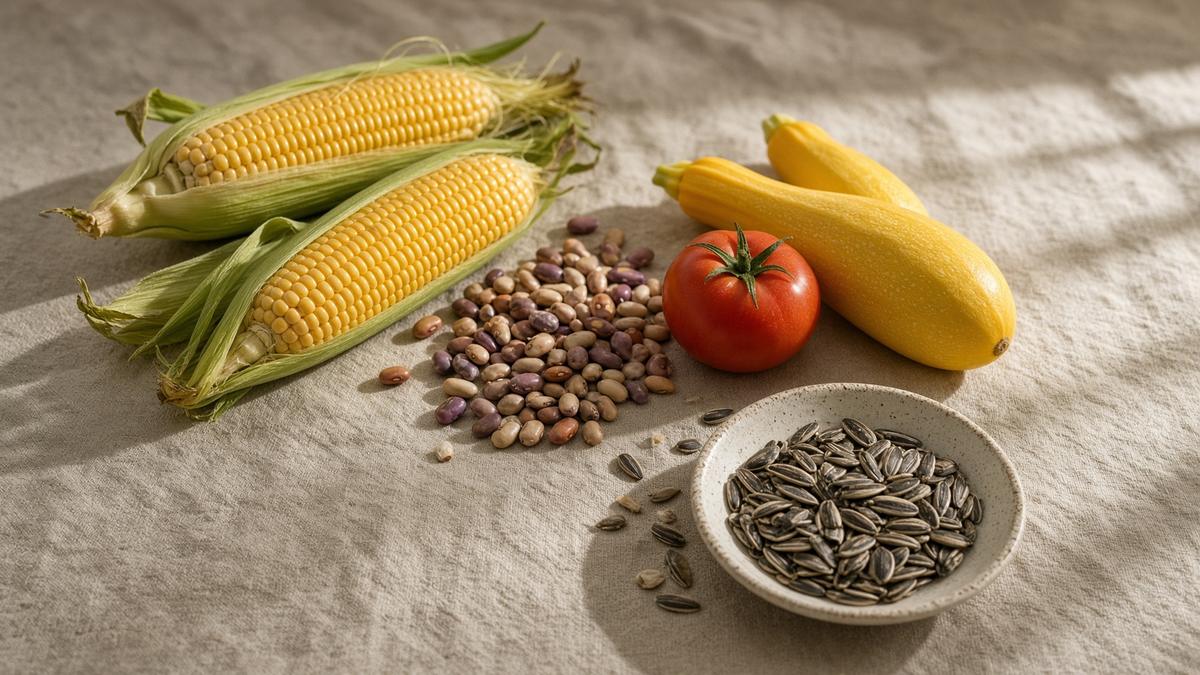
For many Native American nations, plants, not buffalo, were the main food, with corn, beans, and squash at the center[1][3]. Some traditions fed children no meat until about age ten[9]. Cows, pigs, chickens, and even honey bees were brought over by colonizers[4][6], and so was the hamburger.
What the evidence says
The main points first. Every claim is tied to a source below.
Most Native American nations didn’t live by hunting buffalo
Choctaw and Cherokee scholar Rita Laws, Ph.D., writes that the image of Plains horsemen hunting buffalo came late, was limited to the Plains, and grew after Europeans brought horses and guns[1]. The Choctaw lived on corn, pumpkin, beans, and acorn bread, and ate small game only occasionally[1]. Many nations never “lost the corn,” and meat was the exception rather than a sacrament[2].
Read full article →Corn, beans, and squash were the original American staples
Corn, beans, and squash are planted together so that each helps the others grow[1]. The Iroquois and Cherokee called them the Three Sisters[1], and the USDA still teaches the method[1]. Rita Laws notes that nearly half the plant foods grown on Earth were first cultivated by American Indians, including corn, beans, squash, tomatoes, potatoes, peanuts, cacao, vanilla, sunflowers, and cranberries[2]. The continent was already productive farmland[1].
Read full article →Cows, pigs, and chickens aren’t native to the Americas
Before 1492, there were no cows, pigs, chickens, sheep, goats, or horses in the Americas[1][2]. Columbus brought cows, pigs, and chickens on his second voyage in 1493[2], so the animals that now fill U.S. factory farms arrived with colonization[1][2]. The hamburger is an import, not an Indigenous food[1][2].
Read full article →The European honey bee isn’t native to North America
According to the U.S. Geological Survey, the European honey bee (Apis mellifera) isn’t native to North America[1]. English colonists brought hives to Virginia in 1622[1][2], and some Native nations called the bees “white man’s flies”[2]. Thousands of native bee species already lived here[1], and Mesoamerica had stingless bees of its own. Commercial beekeeping arrived with the colonists[1][2].
Read full article →In Cherokee tradition, people first lived alongside animals without killing them
James Mooney recorded a Cherokee story in which humans, plants, and animals first lived as equals, without killing[1]. When humans began eating animals, the animals invented disease, and the plants, still friendly, became medicine[1]. Rita Laws puts it alongside the beliefs of other nations whose afterlife is full of fruit rather than flesh[2]. In each of them, the world goes wrong when people start killing.
Read full article →Aztec, Maya, and Zapotec children didn’t eat meat until they were older
Rita Laws writes that Aztec, Maya, and Zapotec children ate only plant foods, mostly corn, until at least age ten[1]. Families believed this made a child strong, less likely to get sick, and more likely to love grain for life[1]. Healers told sick people to “return to the arms of Mother Corn,” and atole, a corn drink, was treated as a sacred food[1][2]. Laws is describing a tradition, not a modern nutrition study, but in that tradition meat was put off rather than treated as something a child needed[1].
Read full article →Many Native nations kept farming even with buffalo nearby
Rita Laws names Osage, Pawnee, Arikara, Mandan, Wichita, and Caddoan towns where people lived in timber-and-earth houses and kept farming even with buffalo nearby[1]. In the Southeast, the Creek, Chickasaw, and Choctaw didn’t depend much on killing animals[1]. She argues that hunting was mostly a side activity until horses and guns made the buffalo hunt a way of life for some Plains groups[1]. Ceremonies often used tobacco instead of meat, and harvest festivals were built around corn[1].
Read full article →Squanto taught the Pilgrims to grow corn and live on plants
Rita Laws notes that Squanto, a Pawtuxet man, taught the Pilgrims how to grow corn and live on plant foods[1]. George Catlin, traveling through Choctaw country in the 1830s, described land almost covered in grapes, plums, currants, gooseberries, and prickly pear[1]. His book came out in 1841[1]. So the first farming the English learned in America was growing plants, long before buffalo and steak became the popular image of American food.
Read full article →Articles
Corn, beans and squash fed this continent long before cows arrived
For many Native nations, plants were the center of the diet, especially corn, beans and squash, the Three Sisters. Cows, pigs and chickens only arrived with European colonists, and so did the honey bee used for commercial honey.
Read full article →
Sources
Papers and datasets. Each card keeps its caveats, including small samples and single-animal cases.
[1]IVU / Vegetarian Journal, 1994 · Review
Most Native American nations didn’t live on buffalo, Rita Laws writes
Rita Laws, Ph.D., a Choctaw and Cherokee scholar, writes that the buffalo-hunting Plains stereotype doesn’t describe most of Native America. Choctaw food was corn, pumpkin, beans, and acorn bread, and small game was eaten only now and then. Hunting became a main occupation for some nations after the horse and the gun arrived, and many nations kept farmed plants at the center of their diet.
[2]Indian Country Today · Review
Meat was the exception in the pre-colonial Choctaw diet, Laws says
In an interview with Indian Country Today, Laws says Choctaw people weren’t vegetarians “on purpose.” Meat was the exception rather than the rule, because farmed plants fed the nation. After contact, some Indigenous diets shifted toward animals while settlers shifted toward vegetables.
[3]USDA National Agricultural Library · Review
The Three Sisters of Indigenous American agriculture
The USDA’s National Agricultural Library explains the Three Sisters: corn, beans, and squash planted together, with the corn as a trellis, the beans fixing nitrogen, and the squash covering the ground as mulch. The Iroquois and Cherokee called them sisters because they nurture each other like family. This farming was already in place before colonization.
[4]Gilder Lehrman Institute · Review
The Americas had no cows, sheep, or goats before Europeans came
The Gilder Lehrman Institute’s summary of Alfred Crosby’s work on the Columbian Exchange says there were no horses, cows, sheep, or goats in the Americas when Europeans arrived. Pigs, cows, and chickens came over with the colonists, so the farm-animal industry here was imported.
[5]Columbian exchange · Review
Columbus brought cows, pigs, and chickens to the Americas in 1493
Cows, chickens, pigs, sheep, goats, horses, and bees were all brought over from the Old World in the Columbian Exchange. Columbus’s second voyage, in 1493, carried cows, pigs, and chickens. The cows, pigs, and chickens whose flesh dominates U.S. plates today aren’t native species.
[6]U.S. Geological Survey · Review
Honey bees aren’t native to North America, says the USGS
The U.S. Geological Survey says honey bees (Apis mellifera), the species used to produce honey commercially, aren’t native to North America. They were brought from Europe in the 17th century, and English colonists shipped hives to Virginia in 1622. Thousands of species of native bees already lived here.
[7]Virginia Places · Review
Honey bees arrived at Jamestown in 1622
Honey bees (Apis mellifera) arrived at Jamestown in 1622. As the swarms spread west ahead of the settlers, some Native nations called them “white man’s flies.” Honey from this bee isn’t a traditional Indigenous food in the United States.
[8]Mooney, Myths of the Cherokee · Review
In a Cherokee story, disease began when people started eating animals
In the Cherokee story recorded by James Mooney, humans, plants, and animals began as equals, and nobody killed. When humans ate the animals, the animals invented diseases, and the plants offered medicine. There was no hunting in the original peaceful world.
[9]IVU / Vegetarian Journal, 1994 · Review
Aztec, Maya, and Zapotec children ate no meat until about age ten, Laws writes
Rita Laws writes that Aztec, Maya, and Zapotec children ate fully plant-based diets, mostly corn, until at least age ten, because families believed it made them strong and less likely to get sick. Healers told sick people to return to Mother Corn, and Spanish observers were struck by how long people lived. Laws is describing tradition here, not a modern clinical trial.
[10]Mexicolore · Review
The Aztec diet was mostly vegetables, fruit, and grains
Mexicolore explains that with no cows, sheep, or goats, the Mexica (Aztec) diet was mostly vegetables, fruit, and grains. Maize was the main staple, eaten as tortillas, pozole, and atole. Rita Laws describes children’s plates the same way, with corn at the center.
[11]IVU / Vegetarian Journal, 1994 · Review
Even nations living near buffalo kept farming towns, Laws writes
Laws writes that the Osage, Pawnee, Arikara, Mandan, Wichita, and Caddoan peoples kept permanent farming towns built of timber and earth, even with buffalo nearby. In the Southeast, the Creek, Chickasaw, and Choctaw relied little on killing animals. The buffalo-hunting way of life spread after horses and guns arrived, and before that, hunting had often been a side activity.
[12]IVU / Vegetarian Journal, 1994 · Review
Squanto taught the Pilgrims to grow corn and live on plant foods
Laws writes that Squanto, a Pawtuxet man, taught the Pilgrims to grow corn and live on plant foods. In Choctaw country in the 1830s, the painter George Catlin described so many grapes, plums, currants, gooseberries, and prickly pears that they slowed his travel. His book came out in 1841. The land Laws describes was farmed and full of wild plant food.