Evolution
It takes tools, not canine teeth, to make a human a hunter
Plant-basedWhat anatomy, senses, and instinct point to
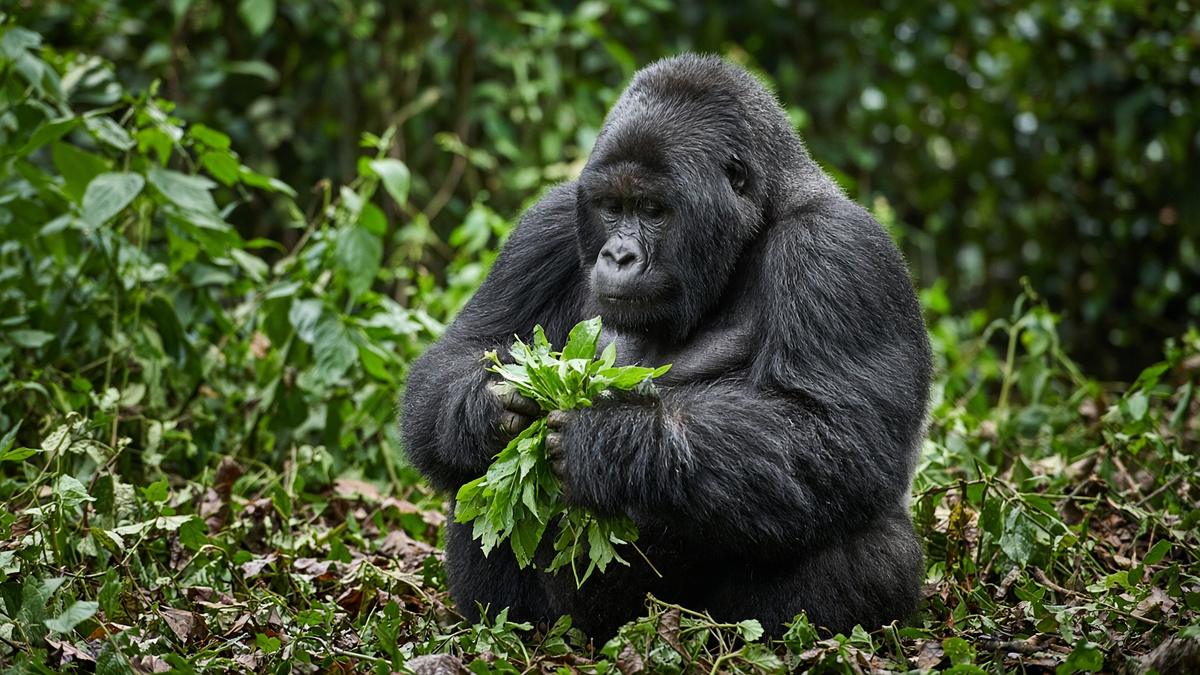
Without tools, humans can barely kill or eat animals[1]. Our nails and teeth can’t get through hide[2], and raw meat is tough and bland without cooking and seasoning[4][5]. Many plant-eaters, like gorillas and geladas, have far bigger canines than we do[7][16], and most bears eat mostly plants[17]. Our eyes evolved to spot ripe fruit[22], and we can’t make our own vitamin C, so we need plants for it[25]. And to most people, a dead animal looks and smells disgusting[20].
What the evidence says
The main points first. Every claim is tied to a source below.
Without tools, a human cannot take down a large animal
Human nails are thin and flat, and our teeth are short and blunt compared with a cat’s, so neither can get through fur, hide, or connective tissue[2]. A lion can kill and eat its prey with nothing but its own body, while a person needs a tool with a sharpened edge[1]. The Smithsonian notes that people used stone tools for more than 2 million years to cut and pound food, including meat, and that wooden spears for hunting large animals appear around 500,000 years ago[1]. Those dates are sometimes treated as proof that we were meant to eat meat, but what they show is that without a sharp edge, a human can’t open a hide or bring down a cow[1].
Most raw meat is too tough to eat easily, and cooking is what made it workable[3]. Unseasoned meat is mostly bland, and apart from the salt, the things that flavor it, like herbs and sauces, come from plants[3][4]. Hunting, skinning, and enjoying a carcass all depend on tools and a kitchen, not on the human body.
Read full article →Forward-facing eyes and big canines don’t make an animal a hunter
Every living primate has forward-facing eyes, which help it judge the distance to a branch[1], and most monkeys and apes have nails like ours instead of claws[2]. Male geladas[3], mandrills, baboons, gorillas[6], and orangutans[7] have canines much larger than ours, used mainly for display and defense. But geladas eat grass about 90% of the time[3], howler and colobus monkeys live on leaves[4], orangutans live mostly on fruit[7], and giant pandas kept carnivoran canines and claws but eat almost nothing but bamboo[5]. Even the primates people point to as hunters eat very little meat: about 1–2% of a wild chimpanzee’s diet[9], a small, opportunistic share for baboons[11], and a marginal protein source for bonobos[10].
Read full article →Inland grizzlies have long claws and still eat about 80–90% plants
Bears are a favorite example for people who say “we have canines, so we hunt,” but the National Wildlife Federation puts plants at about 80 to 90 percent of what inland grizzlies and brown bears eat: roots, tubers, grasses, and berries[1]. Yellowstone grizzlies ate 162 plant species, and their claws, up to 10 cm long, dig up biscuitroot as often as they open a carcass[1][2]. Black bears get most of their diet from berries, fruit, and sedges[3]. Coastal brown bears eat more salmon, but that’s because of the fish runs[1][2], not evidence that bears are built to hunt.
Read full article →Our jaws grind side to side, while a cat’s mostly just move up and down
A cat’s jaw is a hinge that moves up and down so its carnassial teeth can scissor flesh, and it barely moves sideways[1]. Our jaw joint sits above the tooth row, with a disc that lets the lower jaw slide forward and side to side, which is how our molars crush and grind[1]. We have spade-shaped incisors, small, blunt canines that work like extra incisors, and squarish, bumpy molars made for grinding rather than slicing[1]. Milton Mills, comparing our anatomy with that of carnivores and plant-eaters, concludes that the human mouth is built for chewing plants, not for tearing through hide[1].
Read full article →Like horses, we cool off by sweating, while cats and dogs pant
Humans shed heat through eccrine sweat glands spread over the whole body[1]. Cats and dogs have few of those glands, so they cool off by panting[1], evaporating water from the tongue and mouth. The other well-known sweaters are horses and some other primates, and both are plant-eaters[1]. A body that sweats through its skin while on the move in the heat of the day is built like a daytime forager[1], not a night hunter.
Read full article →Our eyes are built for finding ripe fruit by day, not hunting at night
Humans, apes, and Old World monkeys see reds and greens[1], and Dominy and Lucas argue that this trichromatic color vision helps a primate pick ripe fruit and young leaves out of a green canopy[1]. Dogs and cats are dichromats[2]: they see some color, mostly in the blue-yellow range[2], but they can’t tell red from green the way we do when we look for berries[2]. We also lack a tapetum lucidum, the reflective layer behind the retina that makes a cat’s eyes glow and helps it hunt at night[3]. Haplorhine primates, including us, are daytime animals[3].
Read full article →We lost the ability to make vitamin C, so we depend on plants for it
Most mammals make their own vitamin C[1]. Humans, other anthropoid primates, guinea pigs, and some fruit bats lost a working GULO gene, so the vitamin has to come from food[1]. Fresh meat is a poor source, and fruit, leaves, and other plants are the reliable ones[1]. A species can only lose that gene without harm if its diet keeps supplying vitamin C, which means it kept eating plants[1].
Read full article →We start digesting starch in the mouth and have a plant-eater’s long gut
Human saliva contains amylase, the enzyme that starts digesting starch in the mouth[2]. Perry and colleagues found that humans carry extra copies of the AMY1 gene, and more copies in populations that eat a lot of starch[1], something a carnivore has no need for. Milton Mills puts the human gut at roughly ten to eleven times body length, in the plant-eater range rather than a carnivore’s short tube[2], and Beasley puts our baseline stomach pH near 1.5, close to a rabbit’s[3]. We also sleep at night, like other daytime primates. Starch is still the human staple worldwide: rice, wheat, corn, potatoes, and beans[1].
Read full article →Most people wouldn’t hurt a cow or a chicken with their own hands
Ask people whether they would hurt a dog, a cow, or a chicken with their own hands, and most say no[1]. Pew found that 97% of U.S. pet owners say their pet is part of the family[2]. Our first instinct is to pull back, not to kill[1][2], and without a weapon most of us couldn’t take an animal down anyway. Loughnan, Bastian, and Haslam describe the meat paradox: people care about animals and eat them anyway, and they cope by hiding the body, denying that the animal has a mind, and renaming the dead animal as food[1].
Read full article →The whites of our eyes show where we’re looking, which would give a hunter away
Humans have white sclera[2], and Kobayashi and Kohshima, and later Tomasello, argue that the whites of our eyes make it easy to see where we’re looking[2]. Eyes that are easy to read help people cooperate[1][2], but they’re no help in sneaking up on prey[2], and a cat’s eye has no white to give it away[1][2]. We also sleep through the night. We’re built as social, daytime animals that share attention, not as silent hunters[1][2].
Read full article →Cooked starch, not just meat, likely fed the growing human brain
Brain tissue burns through glucose, and Hardy and colleagues argue that our ancestors’ growing brains needed cooked starch to supply it, not just muscle meat[1]. Lions eat meat and never grew brains like ours, while humans made porridge, rice, bread, and tubers the global staple. Our DNA carries extra copies of the gene for salivary amylase, the enzyme that breaks down starch[2], and grains, tubers, and beans are still the world’s main foods. The idea that meat alone grew our brains is the less plausible one[1].
Read full article →People who don’t eat animals have less heart disease, cancer, and diabetes
People who skip meat and other animal products have the lowest measured risk of heart disease, less cancer overall in a 2026 review that called the vegan evidence limited[3], the lowest risk of type 2 diabetes[4], and less obesity. The only diets shown to reverse coronary plaque in people had no meat[2]. Vegetarians came out ahead in endurance tests, including the old Yale ones. Processed meat is linked with more dementia, and plant-based eating with less[5]. The human body wasn’t built to hunt, and it does better when we don’t eat animals.
Read full article →Articles
The human body was not built to hunt
Our flat nails, blunt teeth and grinding jaws can’t get through a hide, our eyes are tuned to spot ripe fruit, and we sweat all over like an animal that gathers food through the heat of the day. Killing and eating a large animal took stone tools, spears and fire.
Read full article →
Big canine teeth do not make an animal a meat eater
Geladas, gorillas, pandas, hippos and bears all have much bigger canines than ours, and pandas and bears have claws too, yet they live mostly or entirely on plants. Even chimpanzees, which do hunt, get nearly all their food from plants.
Read full article →
The human body is built around starch
We can’t make our own vitamin C, our saliva starts digesting starch before we swallow, and cooked starch likely fueled the growth of the human brain. Today, people who eat no animals have the lowest risk of several major diseases.
Read full article →
Share this argument
One claim per screen. Screenshot it or send the link.
Share card
Canine teeth aren't for meat
Pandas, geladas, gorillas, orangutans and others all have larger canine teeth than humans, and they live almost entirely on plants.
Sources
Papers and datasets. Each card keeps its caveats, including small samples and single-animal cases.
[1]Smithsonian Human Origins · Review
Early humans needed stone tools and spears to eat and kill large animals
The Smithsonian notes that early humans used stone tools for more than 2 million years to cut, pound, and crush food, including meat from large animals, and that wooden spears for killing large animals appear about 500,000 years ago. People needed those tools because hands and teeth can’t open a hide or bring down a large animal, which a cat does with no blade at all.
[2]Mills, comparative anatomy essay · Review
Milton Mills on why human teeth, jaws, and guts are built for plants
Milton Mills, M.D., points out that humans have no carnassial (shearing) teeth, just closely packed grinding molars, blunt canines that work like extra incisors, and flat nails instead of claws, so our teeth and nails can’t cut through fur, hide, feathers, or connective tissue the way a cat’s can. Our jaw joint sits above the tooth row and moves forward and side to side for grinding, while a cat’s jaw is a hinge that chops. Our gut, roughly ten to eleven times body length, is closer to other plant-eating primates’ than to a cat’s, and our saliva contains amylase.
[3]Journal of Human Evolution, 2018 · Observational
Sweating all over is a primate trait that humans took further
Best and Kamilar found that eccrine sweat glands over the body surface are a trait of catarrhine primates (Old World monkeys and apes), expanded in humans. According to Wikipedia’s overview, dogs and other mammals with few sweat glands cool off by panting, while horses and some primates, both plant-eaters, sweat too. Sweating over the whole skin is a cooling system for animals that forage by day.
[4]Comparative Biochemistry and Physiology, 2003 · Review
Cooking is part of human biology, and raw meat is hard to eat, Wrangham argues
Richard Wrangham points out that many plant foods are too fibrous to eat raw, and most raw meat is too tough to chew easily. He treats cooking as a human biological trait, since without heat, flesh is hard to eat. Cooking, salt, and plant seasonings account for most of what makes meat pleasant to eat.
[5]IOM, Strategies to Reduce Sodium Intake, 2010 · Review
Plain meat is mostly bland without salt and plant seasonings
The Institute of Medicine says added salt improves the flavor of nearly every food people eat, and without it food often tastes bad. Unseasoned meat is mostly bland, and the herbs, spices, and sauces people add to it are plants, the same ones used on meat substitutes.
[6]BBC Future · Review
Forward-facing eyes help primates judge distance in the trees
BBC Future explains that a long-standing reason given for why human eyes face forward is judging distance while moving through trees, rather than hunting large prey. Almost every monkey and ape has the same binocular vision, which comes with living as a primate in three dimensions.
[7]San Diego Zoo · Review
Geladas have huge canines and a diet that’s over 90% grass
The San Diego Zoo says geladas are the only grazing monkey, and grass blades make up over 90% of their diet. Males flash some of the largest canines of any primate, but as a threat display, not for hunting.
[8]Encyclopaedia Britannica · Review
Colobus monkeys live on leaves and have forward-facing eyes
Britannica describes colobus monkeys as having complex stomachs that ferment a vegetarian diet of leaves, flowers, fruit, and seeds. Often called leaf-eating monkeys, they have large bodies, long fingers, and forward-facing eyes.
[9]PLOS ONE, 2016 · Observational
Howler monkeys live on leaves and fruit
Chaves and colleagues found that most feeding records for brown howler monkeys in Brazil were of fruit and leaves. Howlers have forward-facing eyes and sizable canines, and they live in the forest canopy.
[10]WWF · Review
Orangutans mainly eat fruit
WWF says orangutans mainly eat fruit, plus young leaves, flowers, insects, and bark, even though they have large canines and forward-facing eyes.
[11]National Geographic · Review
Hippos have 20-inch canines and eat grass
National Geographic says hippos are herbivores that eat with their molars. Their canines, which can reach 20 inches, are for fighting, not for cutting meat, and a hippo may eat around 110 pounds of grass in a night.
[12]Project Chimps · Review
Meat is less than 2% of a wild chimp’s diet
Project Chimps, summarizing what wild chimpanzees eat, calls them omnivorous fruit-eaters. They do hunt, but meat makes up less than 2% of their diet, and nearly all the rest is plants.
[13]PLOS ONE, 2011 · Observational
Bonobos get nearly all their protein from plants
Oelze and colleagues used stable isotopes to study bonobos at LuiKotale. Bonobos do hunt small vertebrates, but the isotopes show that animal food adds only a marginal share of the protein in their bodies. Fruit, leaves, and other plants supply the rest.
[14]Behavioral Ecology and Sociobiology, 2002 · Review
Baboon diets are mostly fruit, leaves, and underground plant foods
Hill and Dunbar compared baboon populations and found their diets are mostly fruit, leaves, and underground plant foods. Animal food is a much smaller share, and it didn’t vary with climate the way plant foods did. Baboons take meat and insects when they can, but they don’t live on them.
[15]Current Biology, 2019 · Observational
Giant pandas have a carnivore’s canines and eat almost only bamboo
Nie and colleagues describe giant pandas as specialized herbivores that eat almost nothing but bamboo, even though they descend from meat-eating carnivorans. They kept the group’s canines but live on plants, so their canine teeth reflect their ancestry, not their current diet.
[16]Biology Letters, 2011 · Observational
Mountain gorillas live on leaves and have huge canines
Rothman and colleagues found that mountain gorillas eat almost entirely plants, with leaves for most of the year and fruit when it’s available. Males use their canines for display, not for cutting meat. Their forward-facing eyes come with being a primate in a three-dimensional world, not with hunting like a wolf.
[17]National Wildlife Federation · Review
Inland grizzly bears eat 80–90% plants
The National Wildlife Federation says that in many inland areas, plants make up 80 to 90 percent of what grizzlies eat, including roots, tubers, grasses, and berries. They use claws that could kill to dig up biscuitroot, so a body that can hunt still lives mostly on plants.
[18]National Park Service, Yellowstone · Observational
Yellowstone grizzlies eat more than 162 kinds of plants
The National Park Service says grizzlies in the Greater Yellowstone area have eaten more than 162 plant species. Their claws, up to 10 cm long, dig up roots as often as they tear open a carcass. The bears do eat animals, but animal food isn’t most of their diet.
[19]U.S. National Park Service · Review
American black bears eat mostly plants
The National Park Service says most of a black bear’s diet is berries, fruit, sedges, and insects, and park rangers routinely put the plant share at around 85–90%. Black bears have canines and claws and still eat mostly plants.
[20]Current Directions in Psychological Science, 2014 · Review
Psychologists call caring about animals while eating them the meat paradox
Loughnan, Bastian, and Haslam describe the “meat paradox”: people care about animals and also eat them. They explain it as motivated disengagement, where people deny the animal a mind, hide the body, and rename the dead animal as food. A dead animal doesn’t look like dinner until culture relabels it, and disgust at a carcass is the older reaction.
[21]Pew Research Center, 2023 · Observational
97% of U.S. pet owners say their pets are family
A 2023 Pew Research Center survey found nearly all U.S. pet owners (97%) say their pets are part of the family, and about half say they’re as much a part of it as a human member. People who would never hurt the dog at home still pay for animals like it to be killed for dinner. The instinct on display is attachment, not predation.
[22]Nature, 2001 · Observational
Primate color vision evolved to find ripe fruit and young leaves
Dominy and Lucas (Nature, 2001) found that the trichromatic color vision primates routinely have is an adaptation for spotting ripe fruit and young red leaves in a green canopy. It’s the eye of a plant forager, not a night hunter.
[23]Visual Neuroscience, 1989 · Observational
Dogs can’t tell red from green the way humans can
Neitz, Geist, and Jacobs used behavioral tests to show that dogs have two kinds of color cones, not three, and cats are similar. Dogs see some color (blue and yellow) but lack the red-green vision humans use to spot berries. So saying “carnivores cannot see color” goes too far, but they don’t see fruit the way a primate does.
[24]Tapetum lucidum overview · Review
Humans lack the reflective eye layer that helps cats and dogs see at night
Haplorhine primates, including humans, lack a tapetum lucidum, the reflective layer in the eye that gives cats and dogs eyeshine and better night vision. Humans are active by day, and a species that sleeps through the dark isn’t built to hunt at midnight.
[25]Current Genomics, 2011 · Review
Humans can’t make vitamin C, so we have to get it from plants
Drouin, Godin, and Page explain that anthropoid primates, along with guinea pigs and some bats, carry a broken GULO (or GLO) gene and can’t make vitamin C (ascorbic acid), though most mammals still can. Fresh meat is a poor source of vitamin C, while fruit and leaves are reliable ones, so losing the gene only works for a lineage that kept eating plants.
[26]eLife, 2022 · Observational
The whites of our eyes show where we’re looking, which helps cooperation
Kobayashi and Kohshima found that humans have unusually white, exposed sclera (the whites of the eyes), which makes it easy to see where someone is looking, and Tomasello built on this with his cooperative-eye hypothesis. Kano and colleagues (eLife, 2022) found that evenly white sclera helps both humans and chimpanzees follow someone’s gaze. A stalking predator would gain from hiding its gaze, but humans advertise theirs.
[27]Quarterly Review of Biology, 2015 · Review
Cooked starch helped fuel the growing human brain
Hardy and colleagues argue that cooked starch supplied ready-made glucose to the brain, which needs a lot of it. People ate meat too, but the brain’s growth is less likely to have happened without energy from carbohydrates.
[28]Nature Genetics, 2007 · Observational
Humans carry extra copies of a starch-digesting gene
Perry and colleagues found that humans carry more copies of AMY1, the gene for salivary amylase (the enzyme in saliva that breaks down starch), than other primates do, and populations with high-starch diets carry more still. Our genes show adaptation to starch, not to a meat-only diet.
[29]PLOS ONE, 2015 · Review
Humans and rabbits both have stomachs around pH 1.5
Beasley and colleagues put baseline human stomach pH at about 1.5. In their table, the rabbit, a herbivore, is the other mammal with a stomach that acidic, though scavengers as a group still average the lowest pH. Stomach acid works as a filter against germs, and it isn’t evidence that humans are hunters.
[30]Heart-disease review, plus Health cluster · Review
People who don’t eat animals have less heart disease, cancer, and diabetes
In pooled analyses, people who don’t eat animals have the lowest risk of heart disease, and a 2026 review found vegan diets linked with less cancer overall, from limited evidence. Adventist Health Study-2 found they had the lowest risk of type 2 diabetes, Ornish’s vegetarian trial reversed plaque in the arteries of the heart, and no diet that includes meat has been shown to do that. A 2025 study by Li and colleagues linked processed meat with a higher risk of dementia.
[31]Frontiers in Nutrition, 2026 · Review
Healthy plant-based diets are linked with less depression, a 2026 review finds
A 2026 review in Frontiers in Nutrition found that healthy plant-based diets are linked with fewer symptoms of depression, while ultra-processed plant foods are linked with more. It also notes that studies of vegetarians and vegans specifically have found mixed results.
[32]Nutrition Reviews, 2025 · Meta-analysis
In 709,703 adults, the healthiest plant-based diets came with less depression
A 2025 meta-analysis covering 709,703 adults found that, in cohort studies, the healthiest plant-based diets came with a 23% lower risk of depression. Unhealthy plant-based diets came with more depression and anxiety.
[33]Journal of Affective Disorders, 2021 · Meta-analysis
Vegetarians scored higher on depression in a pooled analysis of 13 studies
A 2021 meta-analysis pooled 13 studies of 49,889 people and found that vegetarians scored higher on depression than non-vegetarians, though the results varied a lot from study to study.
[34]Nutrition Reviews, 2025 · Review
Most reviews found no clear link between meat-free diets and depression
A 2025 umbrella review graded the earlier reviews and found that most of them saw no link, or conflicting results, between meat-free eating and depression. Reverse causation is plausible, since people who are already struggling may change how they eat.
[35]PMC · Observational
Vegetarians had the lowest dementia risk of the diet groups compared
Of the diet groups compared, vegetarians had the lowest risk of dementia.